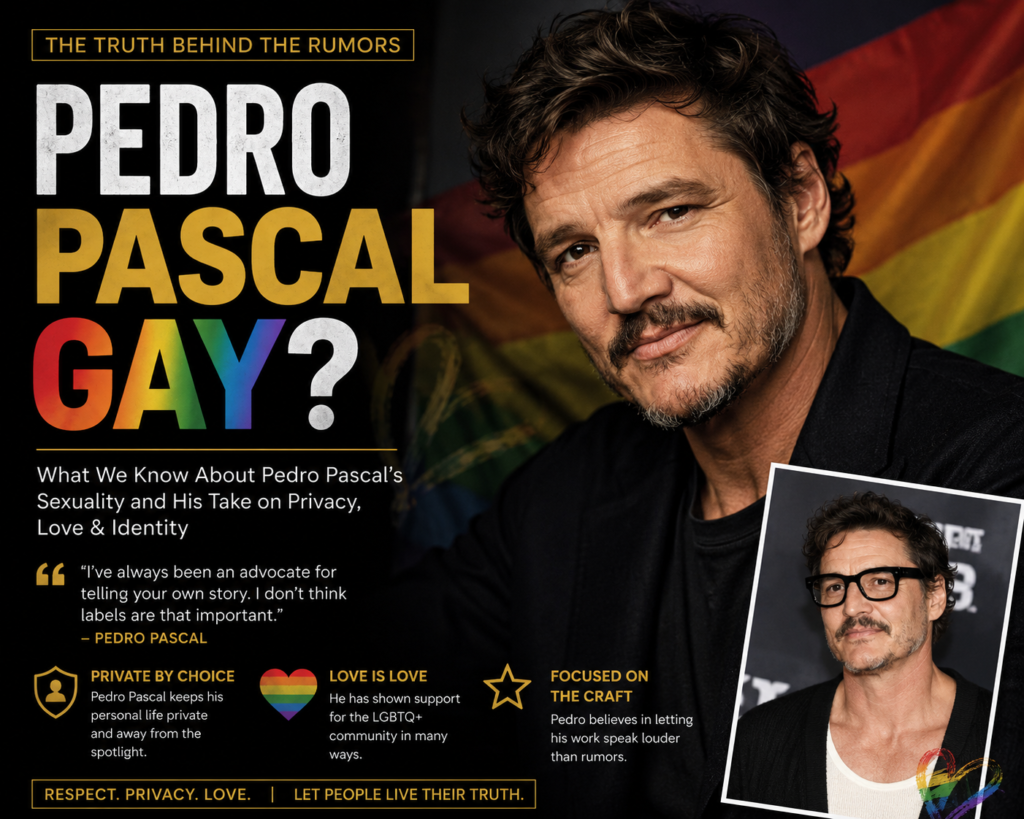
Curiosity about celebrities often stretches far beyond their professional work. For Pedro Pascal the conversation frequently turns to personal matters that he has chosen to keep largely private. Searches and discussions around the phrase pedro pascal gay have circulated for years, fueled by his roles, his open support for LGBTQ communities, and occasional public appearances. Yet the actor himself has never issued a definitive statement labeling his own orientation. This gap between public interest and personal disclosure creates a steady stream of commentary that mixes admiration, assumption, and sometimes frustration.
Understanding the full picture requires looking at what Pascal has actually said, the context of his career, and the broader culture of celebrity speculation. He has described sexuality as a spectrum in past interviews and has remained consistent in protecting the boundary around his intimate relationships. At the same time he has been one of the more visible straight-appearing or unlabeled male stars who actively champions trans rights and queer visibility, largely because of his close relationship with his sister Lux Pascal. The resulting tension between what fans want to know and what he is willing to share sits at the center of why the topic of pedro pascal gay continues to surface.
The Origins of the Ongoing Conversation
The earliest waves of speculation grew out of his breakthrough performance as Oberyn Martell in Game of Thrones. The character was written as bisexual and unapologetically sensual, and Pascal’s portrayal carried a charisma that crossed audience lines. Online communities formed around appreciation for the role, including spaces where viewers of different orientations expressed attraction. Pascal responded to one such discussion by noting that straight men can experience crushes on other men without it rewriting their identity. That measured reply only increased interest rather than settling it.
As his career expanded into The Mandalorian, The Last of Us, and major film projects, the same questions followed. His willingness to wear clothing that challenges traditional masculine norms, his ease with physical affection in public settings, and his frequent appearance alongside queer friends and colleagues kept the discussion alive. None of these elements constitute a declaration, yet they feed the search volume around pedro pascal gay. The pattern is familiar in entertainment: an actor who refuses to perform a rigid public persona becomes a blank canvas for audience projection.
Media coverage has amplified the cycle. Paparazzi photos of Pascal walking with male companions or sharing a yacht with friends are routinely framed through a romantic lens even when the individuals involved later clarify friendship. The recent episode involving model Christian Hogue followed exactly this script. Photos circulated, headlines speculated, and Hogue eventually stated he is not gay and that the gathering was longstanding friendship. Similar clarification has been absent from Pascal himself, which some interpret as deliberate silence and others as simple disinterest in feeding the narrative.
What Pascal Has Actually Said About Identity
In a 2017 conversation with the Los Angeles Times, Pascal addressed the phenomenon of fans developing crushes on his characters and on him. He framed sexuality as a spectrum and observed that heterosexual men can feel attraction without it redefining their orientation. The comment was light, almost playful, and consistent with a person who prefers not to draw hard lines around private experience. He has never followed that remark with a personal coming-out statement or a firm denial.
Later interviews reinforce the same boundary. When asked about his personal life he tends to redirect toward the work or toward broader social issues. In a 2025 Vanity Fair profile he expressed mild confusion at being labeled highly private, explaining that in his actual private world he is open, but that relationships become complicated under intense public scrutiny. The distinction is important. Privacy about romance does not equal secrecy about values. Pascal has been outspoken on political and social matters while remaining reserved about who shares his home or his time.
This approach frustrates some corners of the internet that treat any unlabeled public figure as incomplete until a category is assigned. It also earns respect from others who see the refusal to perform disclosure as a quiet form of integrity. The repeated appearance of the search term pedro pascal gay reflects that unresolved tension more than any new revelation.
Allyship Rooted in Family and Principle
One of the strongest drivers of public association between Pascal and queer communities is his relationship with his sister Lux Pascal. When Lux came out as trans, Pedro was among the first and most consistent supporters. He has spoken about the experience with genuine emotion and has used his platform to criticize policies and public figures that target trans people. Wearing a “Protect the Dolls” shirt, calling out high-profile critics, and appearing at events that center marginalized voices are all documented actions.
Costars have reinforced the impression. Bella Ramsey has described Pascal as a genuine champion rather than a performative ally, noting that conversations about queer experience feel safe and substantive with him. That kind of endorsement carries weight because it comes from someone living the identity in question. Yet allyship and personal orientation are not the same category. Many of the most effective advocates have always been people whose own lives sit outside the communities they defend. Conflating the two is a common shortcut in online discussion and helps explain why the phrase pedro pascal gay trends even in the absence of confirmation.
Pascal’s own words on the subject of support are direct. He has said that persecuting people for living authentically is morally corrupt and that standing up feels like the bare minimum. The language is moral rather than autobiographical. Readers looking for a coded admission will find only consistency of principle.
Career Roles and the Projection Effect
Certain performances invite biographical reading whether the actor intends it or not. Oberyn Martell remains the clearest example. The character’s fluidity, confidence, and eventual vulnerability created an emotional connection that outlasted the episodes themselves. Joel in The Last of Us added another layer of protective, emotionally available masculinity that many viewers found resonant across orientation lines. Reed Richards in the Fantastic Four films continues the pattern of a thoughtful, slightly awkward leading man who does not rely on conventional tough-guy signaling.
When an actor repeatedly inhabits roles that expand the range of acceptable male expression, audiences sometimes assume the expansion must be personal. The assumption is understandable and also frequently wrong. Acting is a craft of empathy and observation. Pascal has spoken about the responsibility of portraying people whose lives differ from his own with care and specificity. That professional ethic can look like lived experience from the outside, especially when the performances are strong.
The cumulative effect is a public image that feels queer-adjacent even if the private reality remains undescribed. Search interest in pedro pascal gay is partly a response to that image. Fans who feel seen by the work want the person behind it to mirror the feeling. When the person declines to supply a matching label, the desire does not disappear; it simply recycles through new photos and new headlines.
Privacy as a Deliberate Practice
Hollywood has long treated personal disclosure as a form of currency. Actors who share relationship details, family milestones, or identity journeys often receive positive coverage and a sense of closeness with their audience. Pascal has largely opted out of that exchange. He appears at premieres, gives thoughtful interviews about craft and politics, and then steps back from the more intimate questions.
The choice has practical consequences. It limits the amount of verified information available, which in turn creates space for rumor. It also protects the people in his life from becoming secondary characters in a public narrative they never signed up for. In an era when phones and cameras turn every dinner or vacation into potential content, the decision to keep certain doors closed is increasingly rare and therefore increasingly noticeable.
Critics of the approach sometimes argue that public figures owe transparency, especially on matters of representation. Supporters counter that no one is entitled to another person’s private reality simply because that person is famous. Pascal’s career success suggests that audiences will continue watching the work regardless of whether the personal file is ever completed to their satisfaction.
Recent Public Appearances and the Rumor Cycle
In early 2026 photographs of Pascal walking arm-in-arm with creative director Rafael Olarra generated a fresh round of headlines. The images showed easy physical affection in public spaces. Neither man issued a clarifying statement, and the silence itself became part of the story. Some observers treated the lack of denial as confirmation. Others noted that friendship between men can include physical warmth without romantic implication, particularly in cultures less rigid about male touch.
A few months later similar speculation attached itself to yacht photographs involving model Christian Hogue. Hogue chose to respond directly, stating he is not gay and that the invitation was based on long-standing friendship. The clarification cooled that particular rumor but did not slow the broader pattern. Each new set of images restarts the same conversation because the underlying question remains unanswered by the principal figure.
These cycles illustrate how the search interest in pedro pascal gay functions less as a quest for new facts and more as a recurring cultural habit. The absence of a definitive statement keeps the topic evergreen. Every friendly outing becomes potential evidence, and every refusal to engage becomes further intrigue.
The Spectrum Comment and Its Lasting Impact
Pascal’s 2017 remark that sexuality exists on a spectrum continues to be quoted whenever the subject arises. The statement was not a personal confession. It was an observation about human experience offered in response to fan behavior. Yet it is frequently treated as the closest thing available to a self-description.
Reading the full context shows a man comfortable with complexity and uninterested in policing other people’s attractions. He expressed flattery at the idea that his work or presence could inspire desire across orientation lines. He did not then pivot to his own category. The gap between the generosity of the comment and the lack of self-labeling is precisely where much of the ongoing speculation lives.
In later years he has not revisited the topic in greater depth. The consistency suggests a settled personal policy rather than evolving uncertainty. People who prefer clear boxes find the approach unsatisfying. People who value autonomy find it refreshing. Both reactions keep the conversation moving.
Fan Culture and the Desire for Representation
A significant portion of the interest in whether pedro pascal gay reflects a broader hunger for visible queer or queer-adjacent figures in mainstream leading-man roles. When an actor projects warmth, emotional availability, and stylistic freedom, queer audiences often claim him as one of their own. The claiming is affectionate and also revealing of how rarely those qualities appear without some accompanying personal disclosure.
Pascal has never discouraged the affection. He interacts with fans across orientations with equal ease and has used his platform to amplify queer voices and causes. That openness to being claimed, combined with the refusal to confirm membership, creates a unique position. He functions as a kind of cultural bridge without ever declaring which side of the bridge he stands on.
The dynamic is not without friction. Some queer commentators argue that unlabeled allies can still center themselves in conversations that should belong to people living the identities. Others celebrate any high-profile figure who expands the range of acceptable masculine presentation. The debate itself generates additional content and additional searches.
Comparing Public Statements Across the Years
Early in his rise Pascal’s comments on the subject were casual and infrequent. As fame increased the questions became more direct and the answers remained similarly bounded. He has never issued a press release, never sat for a dedicated personal essay, and never used award-show stages to address his own orientation. The pattern is deliberate.
Contrast this with actors who have chosen different paths. Some release carefully timed interviews that frame their identity as part of a larger narrative of growth or advocacy. Others remain completely silent and allow the work to stand alone. Pascal occupies a middle space: vocal on solidarity, silent on self-definition. The middle space is comfortable for him and endlessly interesting to observers.
The table below summarizes the publicly available elements that fuel discussion without resolving it.
Element | Public Record | Common Interpretation | Actual Confirmation Level Oberyn Martell role | Bisexual character, highly praised performance | Actor must share some of the character’s fluidity | None Spectrum comment 2017 | Sexuality is a spectrum; straight men can have crushes | Soft self-description | Observation only Support for Lux Pascal | Consistent, emotional, public | Personal stake implies shared identity | Family allyship Photos with male companions | Multiple instances of physical affection | Romantic involvement | Friendship or unknown Past links to women | Several rumored relationships | Evidence of heterosexual history | Unconfirmed by either party Refusal to label | Consistent across interviews | Either privacy or closeted status | Explicit choice
The table makes clear how much of the conversation rests on inference rather than direct evidence. Each row can be read in multiple directions depending on the reader’s prior assumptions.
Quotes That Capture the Public Stance
“I think it’s all a spectrum, right? Straight men can have—do have—crushes on other men. It doesn’t make them gay, it doesn’t make them bi.”
The line from 2017 remains the most frequently cited. It is generous toward audience desire and noncommittal about the speaker.
“I’m very unprivate in my private life. I just know that personal relationships are such a complex thing to navigate even without having this enormous lens on them.”
This later remark from the Vanity Fair conversation explains the boundary without apologizing for it.
“It’s morally corrupt to persecute anyone for being their authentic selves.”
The statement of principle appears in multiple interviews and underpins the allyship that many people associate with the broader topic of pedro pascal gay.
These three comments, taken together, form the bulk of what can be responsibly quoted. Everything else is secondary reporting or speculation.
The Role of Social Media in Sustaining Interest
Platforms reward engagement, and few topics generate reliable engagement like celebrity sexuality speculation. Posts that frame Pascal as secretly gay, newly out, or strategically ambiguous tend to circulate widely. Counter-posts that insist on privacy or point to the lack of evidence circulate as well. The algorithm does not adjudicate truth; it amplifies volume.
Pascal himself participates selectively. He will respond to political or cultural commentary with characteristic bluntness, including the memorable “Yay Gay” reply to critics of his support for queer causes. He does not, however, engage the personal rumors directly. The asymmetry keeps the rumor side of the conversation louder than the factual side.
Over time the repeated cycle can create a false sense of consensus. Newer fans encounter a dense archive of speculative content and may assume the matter is settled. Returning to primary sources—the interviews, the absence of any formal statement—restores the actual state of knowledge.
Hollywood’s Changing Relationship with Disclosure
The industry has moved through distinct eras on this subject. There was a long period when any non-heterosexual identity was considered a career risk and was therefore hidden. There followed a period in which coming out was treated as both personal milestone and public service. The current moment is more fragmented. Some stars still face pressure to disclose; others face pressure to perform allyship without the personal claim; still others simply refuse the entire framework.
Pascal’s career has unfolded across these shifting expectations. He has benefited from greater acceptance of fluid or non-traditional masculine presentation while never being required to supply a matching personal narrative. The result is a form of freedom that earlier generations of actors did not enjoy, paired with a form of scrutiny that earlier generations also escaped.
Whether this balance is sustainable remains an open question. As long as audiences continue to search for pedro pascal gay, the pressure to resolve the ambiguity will persist. Pascal’s consistent response has been to let the pressure exist without yielding to it.
Cultural Masculinity and the Pascal Effect
Part of the fascination lies in how Pascal’s public image rearranges familiar codes of male celebrity. He is frequently described as a “daddy” figure, a term that itself carries layered meanings across straight and queer usage. He appears comfortable in fashion that softens or complicates traditional leading-man styling. He expresses emotion openly in interviews and on red carpets. These traits are not exclusive to any orientation, yet they are still uncommon enough among A-list men to attract commentary.
The commentary often slides from “he expands masculinity” into “he must therefore be gay.” The slide is a category error, but it is a common one. Cultural change rarely proceeds in clean lines. Figures who embody the change become lightning rods for every unresolved question the culture is asking about gender and desire.
Pascal has not positioned himself as a deliberate symbol. He has simply continued working and living in ways that feel authentic to him. The symbolic weight is largely assigned by others. That assignment is what keeps the keyword active.
The Difference Between Allyship and Identity
Clear separation of these two concepts is essential for any honest discussion. Allyship is a set of actions and commitments. Identity is a personal reality that may or may not be disclosed. Pascal’s record on the first is extensive and public. His record on the second is intentionally blank.
Conflating the two does a disservice to both. It reduces genuine support to a form of self-interested signaling, and it pressures private individuals to turn their lives into teaching tools. Pascal’s approach resists that reduction. He supports the communities he supports because he believes the support is right, not because it completes a personal brand narrative.
Readers who approach the subject of pedro pascal gay with this distinction in mind are less likely to feel frustrated by the lack of a neat answer. The answer that exists is already visible in the work and the advocacy. The personal category remains his to share or withhold.
Looking at the Broader Pattern of Celebrity Rumor
Pascal is not unique in attracting this kind of attention. Many actors who project warmth, style flexibility, or progressive politics encounter similar speculation. The difference in his case is the intensity and the longevity of the interest, combined with his near-total refusal to play the game of strategic revelation or denial.
The pattern reveals more about audience needs than about the individual. In a media environment that often feels transactional, the desire for authentic connection is strong. When an actor seems approachable and values-driven, audiences invent the missing biographical details that would make the connection feel complete. The invention is usually affectionate. It is also usually inaccurate.
Recognizing the pattern does not eliminate the curiosity, but it can temper the certainty with which claims are made. The most responsible stance available is the one Pascal himself has modeled: speak clearly about principles, remain quiet about private experience, and let the work carry the rest.
Conclusion
The persistent search interest in pedro pascal gay reflects a collision between a highly visible public figure and a culture that still struggles to accept unlabeled personal lives. Pascal has given audiences exceptional performances, consistent moral clarity on issues of dignity and rights, and almost nothing in the way of intimate self-description. That combination keeps the speculation alive while simultaneously demonstrating that a successful career does not require feeding it. The facts that can be verified remain straightforward: he has never confirmed the label, he has never denied the full range of human possibility, and he continues to prioritize privacy around relationships while remaining vocal on matters of principle. Everything beyond those facts belongs to rumor, projection, or hope. In an industry that often demands more, the restraint itself has become part of his public character.
FAQs
Is there any confirmed statement that answers whether Pedro Pascal is gay?
No public statement from Pedro Pascal confirms or denies a specific sexual orientation. He has described sexuality as a spectrum in general terms and has chosen not to apply any label to himself. Speculation continues, but confirmed information stops at his consistent silence on the personal question.
Why do so many people search for information about Pedro Pascal gay topics?
The combination of charismatic queer-coded roles, visible LGBTQ allyship, stylistic freedom, and deliberate privacy creates ongoing curiosity. Fans and media fill the informational gap with interpretation. The search volume reflects that gap more than any new revelation.
How has Pedro Pascal responded to rumors about his personal life?
He has largely declined to engage the rumors directly. When the subject of attraction or identity arises in interviews he tends to speak in broad, non-personal terms. Clarifications have sometimes come from other people photographed with him, but not from Pascal himself.
Does supporting LGBTQ causes mean an actor must share a matching identity?
No. Allyship and personal orientation are separate. Pascal’s advocacy, especially for trans rights connected to his sister, stands on its own. Many effective advocates have always come from outside the communities they support. Treating advocacy as proof of identity collapses an important distinction.
What should readers keep in mind when encountering claims about Pedro Pascal’s sexuality?
Primary sources show no confirmation. Secondary reporting and social media often treat absence of denial as evidence. The most accurate position remains the one supported by the public record: the question is unanswered because the person at the center of it has chosen not to answer.