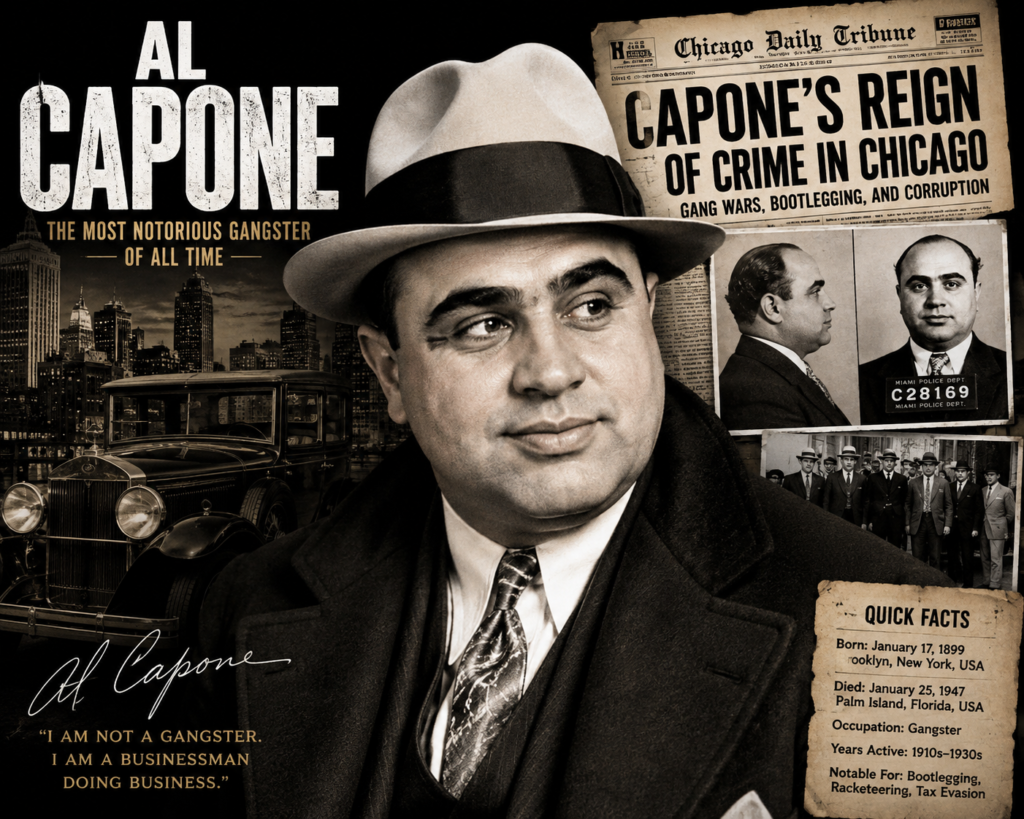
Al Capone remains one of the most recognizable names in the history of organized crime. Born Alphonse Gabriel Capone in Brooklyn, New York, in 1899, he rose from a troubled young man in a working-class neighborhood to become the powerful leader of a major criminal organization in Chicago during the Prohibition era. His story combines ambition, violence, money, politics, law enforcement, and the dramatic transformation of American society during the 1920s.
What makes Al Capone particularly fascinating is not simply the amount of criminal activity associated with him. His influence reached far beyond illegal alcohol. Gambling, prostitution, bribery, protection rackets, and organized violence all became part of the criminal empire connected with his name. At the same time, Capone carefully cultivated a public image that sometimes presented him as a generous businessman or a man of the people, creating a contradiction that helped make him a cultural legend.
Yet the popular image of Capone can sometimes hide the reality of his life. He was not simply a glamorous gangster from an old movie. His organization operated through intimidation and violence, while rival gang members, police officers, witnesses, and ordinary residents could become victims of the criminal environment surrounding Chicago’s underworld. His eventual downfall also demonstrated an important lesson: a criminal empire can appear extremely powerful while still being vulnerable through financial and legal investigations.
Al Capone’s Early Life in Brooklyn
Al Capone was born on January 17, 1899, in Brooklyn, New York, to Italian immigrant parents. His family lived in a working-class environment, and Capone grew up in a neighborhood where street gangs and organized criminal activity were visible parts of urban life. He left school at a young age and became increasingly involved with street gangs. The FBI records that he quit school after the sixth grade and later became associated with a notorious street gang.
As a teenager, Capone became involved with the Five Points Gang, an influential criminal organization in New York. During this period, he developed relationships with older figures in organized crime, including Johnny Torrio. These relationships were important because Torrio would later play a major role in Capone’s move to Chicago and his development as a criminal leader. Capone’s early experiences also introduced him to gambling, extortion, prostitution, and other illegal businesses that would later become part of his larger empire.
The nickname “Scarface” became associated with Capone because of scars on his face, reportedly resulting from a barroom confrontation. Capone disliked the nickname and preferred to be addressed as “Al.” Even so, newspapers and later popular culture turned “Scarface” into one of his most recognizable labels. His early years show that his criminal career did not suddenly begin when he became famous in Chicago. Instead, it developed gradually through street relationships, criminal contacts, and opportunities created by organized crime.
Al Capone’s Move to Chicago
Capone’s move to Chicago was a major turning point in his life. Around 1920, he joined Johnny Torrio in Chicago, where Torrio was already involved in the criminal organization associated with James “Big Jim” Colosimo. The introduction of Prohibition created enormous opportunities for organized crime because the manufacture and sale of alcoholic beverages had been prohibited under federal law.
Instead of eliminating demand for alcohol, Prohibition helped create a profitable illegal market. Speakeasies, bootlegging operations, breweries, transportation networks, and underground distributors became part of a growing criminal economy. Capone quickly recognized the financial potential of this environment. Under Torrio’s influence, he became involved in the organization’s operations and gradually developed the skills and connections that would eventually help him take control.
Chicago was especially important because it provided a large market and an established criminal network. Capone’s organization did not depend on one illegal activity alone. Alcohol distribution could be connected with gambling establishments, prostitution businesses, political influence, and protection operations. This combination allowed the organization to generate substantial revenue while also building influence over parts of the city.
How Al Capone Built His Criminal Empire
Al Capone’s power grew dramatically after Johnny Torrio retired from the Chicago underworld following a serious attack in 1925. Capone then became the leading figure in the organization that would become known as the Chicago Outfit. Under his leadership, the criminal operation expanded and became one of the most powerful organized-crime groups in the United States.
Bootlegging was at the center of the operation. Capone’s organization controlled parts of the illegal alcohol supply chain, from production and distribution to the delivery of liquor to establishments serving customers. But alcohol was only one part of the business. The organization also benefited from gambling, prostitution, extortion, and other rackets. The FBI describes Capone’s empire as being involved in gambling, prostitution, bootlegging, bribery, narcotics trafficking, robbery, protection rackets, and murder.
Money gave Capone more than a luxurious lifestyle. It also gave him influence. Organized crime depended on relationships with corrupt officials, police officers, politicians, and business interests. Such relationships could make investigations more difficult and create an atmosphere in which witnesses were reluctant to cooperate. This helps explain why Capone appeared to operate with remarkable confidence for years despite his public reputation and the widespread knowledge of his criminal activities.
Al Capone, Violence, and the St. Valentine’s Day Massacre
Violence was an important part of Chicago’s organized-crime environment during Capone’s rise. Rival groups competed for control of lucrative territory and illegal businesses, and disagreements could quickly become deadly. Capone’s organization fought with competing gangs during the period often described as the Chicago “beer wars.” The conflict produced numerous killings and helped create Capone’s reputation as a ruthless crime boss.
The most notorious event associated with Capone’s name was the St. Valentine’s Day Massacre on February 14, 1929. Seven members or associates of the North Side Gang were killed in Chicago. Men dressed as police officers reportedly participated in the attack, and the incident shocked the American public. Although Capone was widely suspected of ordering the massacre, he was never convicted for it. This distinction is important because popular culture sometimes presents the event as if Capone personally carried it out or was legally proven responsible.
The massacre nevertheless damaged Capone’s public standing. Newspapers had already made him famous, but the brutality of the killings helped turn him into a national symbol of organized crime. The incident also increased pressure on law enforcement agencies to investigate him. Capone’s reputation had grown so large that he was no longer merely a Chicago criminal figure. He had become a national public-relations problem for American law enforcement.
Al Capone’s Public Image and Wealth
One of the strangest parts of Capone’s story was the contrast between his criminal reputation and his carefully managed public image. He could appear in expensive clothing, enjoy restaurants and hotels, and present himself as a successful businessman. He also made highly publicized charitable gestures, particularly during the difficult economic years surrounding the Great Depression. These actions helped create the image of a gangster who was generous toward ordinary people.
That image, however, should be treated carefully. Charity did not erase the violence and exploitation connected with Capone’s organization. A criminal empire built on illegal alcohol, gambling, prostitution, bribery, and protection rackets generated enormous wealth while contributing to corruption and violence. The charitable side of his public persona was therefore only one part of a much larger and more complicated picture.
Capone’s wealth also became an important part of his legend. Popular accounts have sometimes placed his fortune at extremely high figures, but precise estimates of criminal wealth from the 1920s are difficult to establish. What is clear is that his organization handled very large sums of money. The scale of that money eventually became one of the reasons investigators were able to attack him through tax law rather than relying solely on proving individual acts of violence.
Why Law Enforcement Struggled to Stop Al Capone
For years, bringing Capone to justice was extremely difficult. His organization benefited from intimidation, corruption, financial resources, and a network of associates. More importantly, the federal government did not always have an easy legal route for prosecuting someone believed to be behind local crimes. The FBI notes that even when Capone was widely suspected of involvement in serious gang killings, those killings were not necessarily federal offenses that the Bureau could directly prosecute him for.
Law enforcement agencies gradually changed their strategy. Rather than focusing only on proving that Capone ordered murders or controlled bootlegging operations, investigators began examining his finances. Federal authorities looked closely at whether the enormous income associated with his lifestyle had been properly reported to the government. This approach became crucial because financial records and tax obligations created a different kind of legal case.
Capone also made mistakes that increased pressure on him. In 1929, he was investigated after failing to appear as required before a federal grand jury. Authorities challenged his claims about being too ill to travel, and investigators found evidence that contradicted his story. He was arrested in Florida and later faced additional legal trouble in Philadelphia for carrying a concealed weapon. These events weakened the impression that he was untouchable.
The Tax Evasion Case That Brought Capone Down
The most important legal battle against Al Capone was ultimately not a murder prosecution or a direct conviction for bootlegging. It was a tax case. Treasury Department investigators examined Capone’s finances and gathered evidence that he had failed to pay federal income taxes on substantial income. The strategy was simple in concept but powerful in practice: if authorities could not easily prove every crime connected to Capone, they could still prosecute him for failing to meet his tax obligations.
In 1931, Capone was convicted of federal income-tax violations. On October 24, 1931, he was sentenced to 11 years in prison, along with financial penalties. The sentence effectively ended his reign as Chicago’s dominant crime boss. The FBI describes the conviction as the decisive event that brought his criminal career to an end.
The case became famous because it demonstrated how financial investigations could be used against powerful criminals. Capone had spent years avoiding prosecution for many of the crimes attributed to his organization, but tax law gave federal authorities a concrete path to conviction. His downfall became a classic example of investigators following the money when direct criminal cases were difficult to establish.
Al Capone at Alcatraz
After his conviction, Capone served time in federal prisons, including the U.S. Penitentiary in Atlanta. In 1934, he was transferred to Alcatraz, the federal prison on an island in San Francisco Bay. Alcatraz had been developed as a high-security institution designed to hold particularly difficult or dangerous federal prisoners. Capone became one of its most famous inmates.
Life at Alcatraz was dramatically different from Capone’s earlier lifestyle. Instead of controlling an enormous criminal network, he was simply Prisoner 85. His movements were restricted, his communication was controlled, and his ability to influence the outside world was severely limited. Accounts of his time there describe him as keeping a relatively low profile, doing prison work, reading, and even becoming interested in music.
Capone’s health also deteriorated significantly during his imprisonment. He suffered from advanced syphilis, which affected his physical and mental condition. His illness became increasingly severe during the later part of his sentence. He was eventually released early in 1939 after serving much of his sentence and returned to Florida, where he spent the remainder of his life away from his former position of power.
Al Capone’s Final Years and Death
When Capone returned to Florida in 1939, the man who had once dominated Chicago’s underworld was no longer capable of running the same criminal empire. His health had deteriorated considerably, and the effects of syphilis had damaged his mental and physical condition. The Chicago underworld continued without him, demonstrating that organized crime had become larger than the personality of one individual.
Capone spent his final years largely away from the public life that had made him famous. He lived in the Miami area and received medical care as his health worsened. Although newspapers and the public remained interested in him, his practical influence over organized crime had largely disappeared. The dramatic contrast between his years of power and his later isolation made his decline particularly striking.
Al Capone died on January 25, 1947, in Florida, just eight days after his 48th birthday. His death marked the end of the life of one of America’s most famous organized-crime figures. His story, however, continued through books, documentaries, movies, television programs, historical studies, and popular culture.
The Historical Legacy of Al Capone
Al Capone’s historical importance goes beyond the question of how much money he made or how many crimes were associated with his organization. His career reflected the unusual circumstances of Prohibition-era America. When alcohol was banned, demand did not disappear. Instead, an illegal market developed, and criminal organizations moved quickly to satisfy it. Capone became one of the most successful figures in that environment.
His story also demonstrates the relationship between organized crime and corruption. Criminal organizations need more than criminals to survive at a large scale. They often depend on financial systems, transportation networks, businesses, political relationships, and people willing to look the other way. Capone’s power therefore represented not only personal ambition but also weaknesses within the institutions surrounding him.
Perhaps the biggest lesson from Capone’s downfall is that public reputation and real legal power are not the same thing. For years, he seemed almost impossible to defeat. Eventually, investigators found a legal weakness through financial evidence. His conviction showed that even a criminal leader with money, influence, and an intimidating reputation could be brought down through persistent investigation and careful use of the law.
Al Capone in Movies, Books, and Popular Culture
Few criminals have had a stronger influence on popular culture than Al Capone. His recognizable appearance, nickname, wealth, Chicago background, and dramatic downfall have made him an ideal character for filmmakers and writers. Movies and television productions have repeatedly used Capone or fictional characters inspired by him to represent the classic American gangster.
One famous example is The Untouchables, the 1987 film directed by Brian De Palma, in which Robert De Niro portrayed Capone. The movie helped reinforce the image of Capone as a larger-than-life gangster surrounded by violence, expensive suits, political corruption, and determined federal investigators. However, films often dramatize historical events, so entertainment portrayals should not automatically be treated as precise historical records.
The continued fascination with Capone says something interesting about American culture. Audiences are often drawn to stories about people who gain enormous power and then lose it dramatically. Capone’s life has all the ingredients of that kind of story: poverty, ambition, criminal success, enormous wealth, violence, national fame, prosecution, imprisonment, illness, and death. That dramatic arc has helped keep his name recognizable long after the Prohibition era ended.
What Made Al Capone So Famous?
Capone became famous because several historical forces came together at the right moment. Prohibition created an enormous illegal alcohol market, Chicago had an established criminal underworld, and newspapers increasingly turned gangsters into national celebrities. Capone understood publicity and knew how to use his reputation to project power. His name became almost as valuable to his legend as his criminal organization was to his finances.
Another reason for his fame was the contrast between his public personality and the brutality associated with his organization. He could appear charming and confident in public while operating within a violent criminal environment. That contradiction made him more interesting to journalists and the public. People wanted to understand how someone associated with serious organized crime could become a celebrity figure.
Finally, his downfall gave his story a satisfying historical ending. Capone did not remain permanently powerful. The same government that struggled to prosecute him for many crimes eventually found a way to convict him for tax violations. His imprisonment and declining health transformed the gangster who had once seemed untouchable into a cautionary historical figure.
Frequently Asked Questions About Al Capone
Who was Al Capone?
Al Capone was an American organized-crime leader who became famous during the Prohibition era. He led the Chicago Outfit during the 1920s and was associated with bootlegging, gambling, prostitution, bribery, protection rackets, and violence. He became one of the most notorious gangsters in American history.
What was Al Capone’s real name?
His full name was Alphonse Gabriel Capone. He was commonly known as Al Capone, while “Scarface” became one of his most famous nicknames because of scars on his face.
Why was Al Capone sent to prison?
Al Capone was ultimately sent to federal prison after being convicted of income-tax violations in 1931. He received an 11-year sentence. His conviction was significant because authorities had struggled to prosecute him directly for many of the violent and organized-crime activities associated with his empire.
Was Al Capone responsible for the St. Valentine’s Day Massacre?
Capone was widely suspected of ordering the 1929 massacre in which seven people associated with a rival gang were killed. However, he was never convicted for the killings. Historical accounts therefore distinguish between the widespread attribution of responsibility and what was actually proven in court.
When did Al Capone die?
Al Capone died on January 25, 1947, in Florida. He was 48 years old. His health had severely deteriorated after years of illness, particularly during and after his imprisonment.
Why is Al Capone still famous today?
Al Capone remains famous because his life combines several major themes of twentieth-century American history: Prohibition, organized crime, political corruption, law enforcement, media culture, and the growth of federal criminal investigations. His story has also been repeatedly adapted into movies, television shows, books, and documentaries.
Conclusion
Al Capone life was far more complicated than the glamorous gangster image sometimes presented in popular entertainment. He rose from a working-class background in Brooklyn, developed connections in New York’s criminal underworld, moved to Chicago, and eventually became the leading figure in one of America’s most powerful organized-crime organizations. His success was built during Prohibition, when the illegal alcohol trade created extraordinary opportunities for criminal groups. His reign was characterized by wealth, influence, corruption, and violence. Yet the same empire that made Capone famous also attracted increasing attention from law enforcement. When prosecutors struggled to prove the full range of crimes associated with him, investigators turned to his finances. The resulting tax case eventually destroyed his freedom and ended his career as a crime boss.
YOU MAY HAVE MISSED