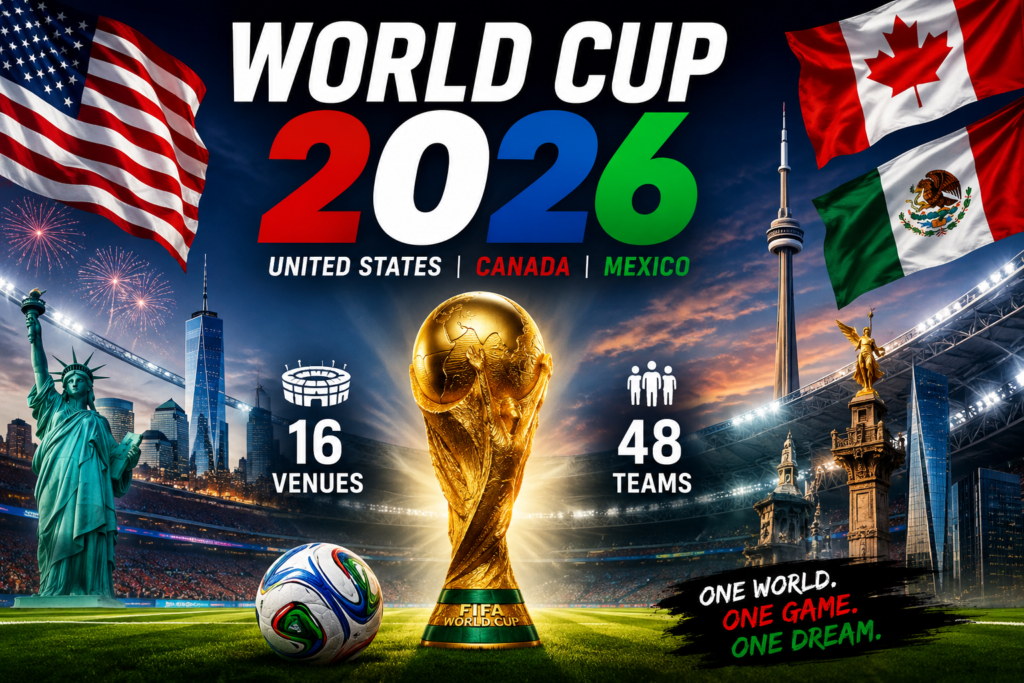
The World Cup 2026 was a historic edition of football’s biggest international tournament, bringing together 48 national teams across Canada, Mexico, and the United States. It was the first FIFA World Cup to feature 48 teams and the first edition jointly hosted by three countries. With 104 matches played across 16 host cities, the tournament offered a much larger football experience than previous editions.
The tournament officially began on June 11, 2026, in Mexico City and concluded on July 19 with a dramatic final at New York New Jersey Stadium. Spain defeated Argentina 1–0 after extra time to become world champions for the second time in their history.
Beyond the results, World Cup 2026 represented a major moment for football in North America. The competition introduced new teams to the world’s biggest stage, gave fans more matches to enjoy, and connected some of the world’s most famous cities through one enormous sporting event. For anyone looking back at the tournament, it was a World Cup defined by expansion, diversity, high-level competition, and memorable football.
What Made World Cup 2026 So Different?
The biggest change in World Cup 2026 was the expansion from 32 teams to 48. This increased the total number of matches from 64 in the previous format to 104, creating a tournament that was considerably larger in both scale and reach. FIFA described the edition as its biggest and most inclusive World Cup to date.
The expansion also changed the experience for supporters. More countries had an opportunity to qualify, meaning fans from nations that traditionally struggled to reach the World Cup could finally watch their teams compete on football’s biggest stage. The tournament therefore felt more global, with a wider range of football cultures represented.
Another major difference was the hosting arrangement. Instead of one country organizing the entire tournament, Canada, Mexico, and the United States shared hosting responsibilities. It was the first time three countries jointly hosted a men’s FIFA World Cup, giving the competition a distinctly North American character.
The Three Host Countries and Their Role
Canada played an important part in World Cup 2026 by hosting matches in Toronto and Vancouver. The tournament marked Canada’s first time hosting men’s FIFA World Cup matches, an important milestone for the country’s growing football culture. The country’s involvement also demonstrated how quickly football has developed across North America.
Mexico brought an extraordinary amount of World Cup history to the tournament. Mexico City was selected to host the opening match, while Mexico itself became the first country to host the men’s World Cup three times. It had previously hosted the competition in 1970 and 1986, making its role in 2026 particularly significant.
The United States hosted the largest share of the tournament’s venues and matches. Cities across the country welcomed teams and supporters, turning the World Cup into a nationwide sporting celebration. The combination of three host nations allowed the tournament to reach an enormous geographical area while exposing international visitors to very different cultures and football environments.
The 16 Host Cities of World Cup 2026
World Cup 2026 matches were played across 16 host cities: Atlanta, Boston, Dallas, Guadalajara, Houston, Kansas City, Los Angeles, Mexico City, Miami, Monterrey, New York/New Jersey, Philadelphia, the San Francisco Bay Area, Seattle, Toronto, and Vancouver.
Each location brought something different to the tournament. Mexico City offered one of football’s most passionate environments, while cities such as Los Angeles, Miami, Seattle, and New York/New Jersey provided enormous international audiences. Canadian cities added another dimension, particularly as the country continued building its football identity.
The geographical spread also made World Cup 2026 unique for traveling supporters. Instead of staying within a relatively compact host country, fans had the opportunity to experience multiple nations and regions. FIFA organized the tournament around regional considerations to help manage the movement of teams and participants across such a large area.
The New 48-Team World Cup Format
The move to 48 teams fundamentally changed the structure of the competition. While FIFA had initially considered a three-team group format, the final tournament structure used 12 groups of four teams. The top two teams from each group, along with the eight best third-place teams, advanced to the knockout stage.
That created a Round of 32 before the traditional progression toward the Round of 16, quarter-finals, semi-finals, and final. The additional knockout round gave more teams a realistic chance to continue their World Cup journey beyond the group stage.
For viewers, the expanded format meant more football and more potential surprises. Smaller nations could test themselves against elite opposition, while traditional powers had less room for mistakes. With 48 teams competing in 104 matches, the tournament delivered an enormous amount of international football over its June-and-July schedule.
The Opening of World Cup 2026
The tournament opened on June 11, 2026, at Mexico City Stadium. Hosting the opening match in Mexico City was a fitting choice because Mexico’s relationship with the World Cup stretches back decades. The country had already hosted memorable editions in 1970 and 1986.
The opening ceremony and first match marked the beginning of a tournament that had been years in preparation. Fans from around the world arrived in North America, while participating teams established training bases and prepared for the demanding competition.
The opening was also symbolic because it represented a new era for the men’s World Cup. Forty-eight teams, three host countries, 16 cities, and 104 matches made the event substantially different from the 32-team tournaments that fans had become accustomed to. FIFA confirmed the June 11 opening date well before the tournament began.
The Road Through the Knockout Stage
Once the group stage was completed, the World Cup moved into its expanded knockout phase. The Round of 32 immediately increased the pressure because one poor performance could end a team’s tournament. Unlike the group stage, there was no opportunity to recover from a defeat.
The knockout matches produced the intensity that fans normally associate with the latter stages of the World Cup. Tactical discipline became increasingly important, while substitutions, set pieces, defensive organization, and individual moments of brilliance often decided tight games.
The tournament eventually narrowed down to the world’s strongest remaining sides. By the time the semi-finals arrived, the atmosphere had completely changed. Every mistake mattered, every goal carried enormous weight, and the possibility of becoming world champion was suddenly within reach.
Spain’s Historic World Cup 2026 Triumph
Spain finished World Cup 2026 as champions after defeating Argentina 1–0 in the final. The match was played on July 19 at New York New Jersey Stadium and went beyond normal time before Spain secured victory in extra time.
The victory gave Spain its second men’s World Cup title. Their first championship came in 2010, meaning the 2026 triumph added another major achievement to a nation with a strong modern football tradition. FIFA’s tournament records list Spain as winners in both 2010 and 2026.
The final itself was a fascinating meeting between two football nations with completely different World Cup stories. Argentina entered as the reigning champions from Qatar 2022, while Spain arrived with an outstanding run of form. Spain’s ability to control the final and find the decisive goal ultimately separated the two sides. FIFA confirmed the final score as Spain 1–0 Argentina after extra time.
Argentina’s Run to the Final
Argentina entered World Cup 2026 with enormous expectations after winning the previous edition in Qatar in 2022. The defending champions had the difficult task of competing under the pressure that naturally comes with being the team everyone wants to beat.
Their journey eventually carried them all the way to the final, where they faced Spain. Reaching the championship match demonstrated Argentina’s continued strength at international level and gave the reigning champions an opportunity to defend their title.
The final was ultimately decided by the narrowest possible margin. Argentina were unable to score, while Spain found the breakthrough during extra time. Although Argentina finished as runners-up, their run to the final ensured that the 2026 tournament once again featured the South American giants at the very top of international football.
Why North America Was an Important Choice
Hosting World Cup 2026 across Canada, Mexico, and the United States was important for the continued growth of football in North America. Soccer had already been developing rapidly in the region, but a tournament of this size offered an opportunity to introduce the sport to even larger audiences.
The United States in particular has a huge sports market and extensive experience with major sporting events. Bringing the World Cup to cities such as Dallas, Los Angeles, Miami, Seattle, Atlanta, and New York/New Jersey created opportunities to connect football with audiences who may traditionally have followed other sports.
Mexico, meanwhile, provided an established football culture and decades of World Cup experience. Canada added another rapidly developing football market. Together, the three countries created a hosting model that combined established football passion with major opportunities for further growth. FIFA also identified the tournament as a potential catalyst for football participation across the host countries.
The Fan Experience During World Cup 2026
One of the biggest attractions of World Cup 2026 was the experience outside the stadiums. Supporters were not simply watching matches; they were participating in a worldwide celebration of football. Host cities organized events and activities designed to welcome international visitors and local fans.
The scale of the tournament meant that millions of people could experience World Cup-related events across North America. FIFA had anticipated around 6.5 million fans attending matches in the three host countries, illustrating the enormous logistical and cultural scale of the event.
The tournament also reached communities beyond the 16 official host cities. Teams established training bases in different locations, allowing additional communities to become involved. FIFA reported that 48 team base camps were established, spreading the tournament’s presence well beyond the stadiums where official matches were played.
How World Cup 2026 Changed Football’s Global Reach
The expanded tournament gave more football associations an opportunity to compete at the highest level. For emerging football nations, simply qualifying for the World Cup can have a huge impact on youth development, investment, infrastructure, and public interest.
Four nations made their World Cup debuts in 2026, including Uzbekistan, according to FIFA’s tournament coverage. Newcomers brought fresh stories to the competition and showed how the global football landscape continues to evolve.
The broader field also meant that football fans could discover players, tactical approaches, and national teams they might not have followed previously. That is one of the strongest arguments for an expanded World Cup: the competition becomes not only a contest between established powers but also a platform for the wider development of the sport.
Technology, Stadiums, and Modern Matchday Football
World Cup 2026 took place in large, modern venues capable of handling enormous crowds and international media operations. The 16 host cities were selected after an extensive process, and FIFA worked with local authorities on transportation, stadium operations, pitch management, and other aspects of tournament delivery.
Technology continued to play an important role in modern football. Video review, advanced match data, communication systems, stadium technology, and digital fan services were all part of the broader World Cup experience. For supporters, digital tools made it easier to follow fixtures, results, standings, venues, and tournament information.
The tournament also demonstrated how major sporting events are becoming increasingly connected. Fans could follow matches through digital platforms while traveling between cities, checking schedules and results from their phones. FIFA’s official World Cup platform provided match information, fixtures, results, standings, and other tournament resources throughout the competition.
Memorable Stories Beyond the Final
Although Spain lifting the trophy was the defining moment, World Cup 2026 produced many stories that extended far beyond the final. The expanded competition gave more national teams an opportunity to create historic moments and compete against some of the strongest sides in world football.
The tournament also created special milestones for host nations. Canada hosted men’s World Cup matches for the first time, Mexico became the first country to host the men’s tournament three times, and the United States welcomed the competition back on a huge scale. These milestones will remain part of the tournament’s history.
For individual players, the World Cup offered another chance to build international reputations. Some established stars arrived carrying enormous expectations, while younger players used the tournament to introduce themselves to a global audience. That mixture of experience and emerging talent is one of the reasons World Cup tournaments remain so compelling.
The Economic and Cultural Impact of World Cup 2026
A World Cup of this size naturally creates economic activity across host countries. Hotels, restaurants, transportation companies, retailers, stadium workers, event organizers, broadcasters, and tourism businesses all become part of the wider tournament ecosystem.
The cultural impact can be just as important. Supporters from different countries spend weeks sharing public spaces, attending matches, discovering local food, and interacting with communities. Football becomes a common language that connects people who might otherwise have little reason to meet.
FIFA also emphasized sustainability, human rights, and long-term legacy planning as important components of the tournament. The organization stated that human rights and sustainability requirements were incorporated into the bidding process and tournament planning.
What World Cup 2026 Means for the Future
The 2026 tournament will likely influence how future World Cups are organized. The 48-team format created more matches and allowed more nations to participate, but it also introduced additional logistical and travel challenges because the host region was geographically enormous.
The tournament demonstrated that a World Cup can be shared across multiple countries while maintaining a strong central identity. Canada, Mexico, and the United States each contributed something different, and the combined approach created a tournament that covered a huge part of North America.
It also showed that football’s global expansion is continuing. With more countries competing and more communities involved, the World Cup is becoming an even broader representation of the sport. Future tournaments will inevitably be compared with World Cup 2026 because of its size, three-country hosting model, and expanded competition.
World Cup 2026 at a Glance
| Feature | World Cup 2026 Detail |
|---|---|
| Host countries | Canada, Mexico and United States |
| Number of teams | 48 |
| Number of matches | 104 |
| Host cities | 16 |
| Opening date | June 11, 2026 |
| Final date | July 19, 2026 |
| Opening venue | Mexico City |
| Final venue | New York New Jersey Stadium |
| Champion | Spain |
| Runner-up | Argentina |
| Final score | Spain 1–0 Argentina after extra time |
| Tournament format | Group stage followed by Round of 32 and knockout rounds |
The numbers alone explain why this tournament was so significant. FIFA expanded the competition from the traditional 32-team format to 48 teams and increased the number of matches to 104. The tournament was played across 16 host cities in three countries.
The final added a memorable conclusion to the entire event. Spain defeated Argentina 1–0 after extra time, securing the country’s second men’s World Cup championship.
For football fans, these statistics provide a quick snapshot, but they do not fully capture the scale of the experience. The combination of football, travel, culture, technology, and international support made World Cup 2026 one of the most ambitious sporting events ever staged.
Frequently Asked Questions About World Cup 2026
Where was World Cup 2026 held?
World Cup 2026 was held across Canada, Mexico, and the United States. Matches took place in 16 host cities distributed across the three countries. FIFA confirmed the tournament as the first men’s World Cup to be jointly hosted by three nations.
How many teams played in World Cup 2026?
A total of 48 national teams participated in World Cup 2026. This was the first edition to use the expanded 48-team format, replacing the previous 32-team tournament structure.
Who won World Cup 2026?
Spain won World Cup 2026. They defeated Argentina 1–0 after extra time in the final on July 19, 2026, at New York New Jersey Stadium. It was Spain’s second men’s World Cup title after their 2010 triumph.
When did World Cup 2026 start and finish?
The tournament started on June 11, 2026, with the opening match in Mexico City. The final was played on July 19, 2026.
Why was World Cup 2026 historically important?
World Cup 2026 was historically important because it introduced a 48-team field, featured 104 matches, and was jointly hosted by Canada, Mexico, and the United States. Mexico also became the first country to host the men’s World Cup three times, while Canada hosted men’s World Cup matches for the first time.
Conclusion
World Cup 2026 will be remembered as a tournament that changed the scale of international football. With 48 teams, 104 matches, 16 host cities, and three host countries, it was significantly larger than previous editions. The competition gave more nations a chance to compete and brought football to communities across Canada, Mexico, and the United States. The tournament also ended with a memorable final. Spain defeated defending champions Argentina 1–0 after extra time on July 19, earning its second World Cup title. That result gave the expanded tournament a fitting conclusion and added another major chapter to Spain’s football history.
Ultimately, the legacy of World Cup 2026 goes beyond the trophy. It demonstrated how football continues to expand globally, how major tournaments can connect multiple nations, and how the World Cup can create opportunities for emerging football cultures. From the opening match in Mexico City to the final in New York/New Jersey, World Cup 2026 delivered an event that will remain an important part of football history for years to come.
YOU MAY HAVE MISSED