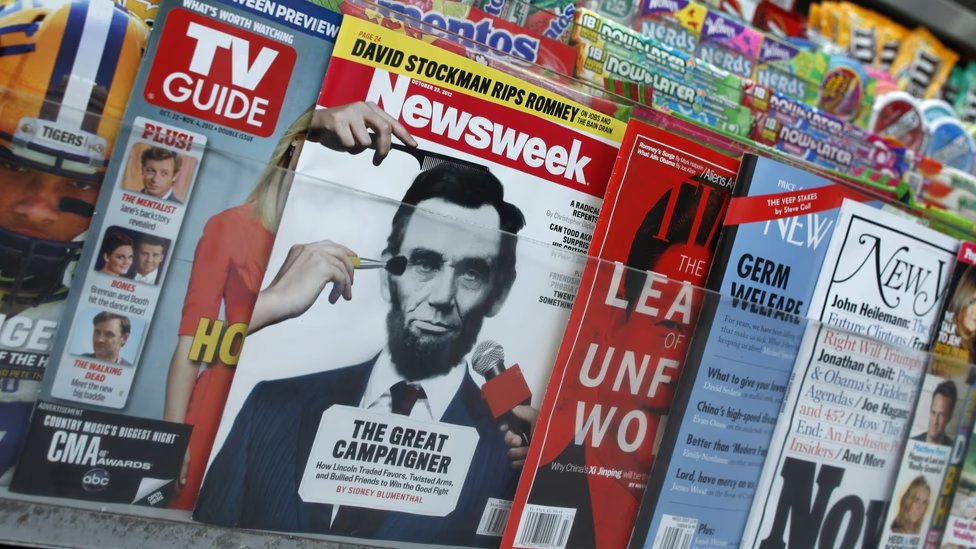
Newsweek is one of the most recognizable names in American journalism. For generations, the publication has been associated with major political stories, international affairs, business, culture, science, technology, and the people shaping public life. What makes the brand especially interesting is not simply its long history, but the way it has repeatedly adapted as the media industry changed around it.
Founded in 1933, Newsweek began as a weekly print newsmagazine during an era when magazines were among the most important ways for readers to understand national and international events. Over time, the publication developed an extensive editorial operation and became part of the American media landscape. Its archives now represent decades of reporting and commentary covering wars, elections, economic changes, social movements, scientific discoveries, and cultural shifts.
The story of Newsweek is also a story about the transformation of journalism itself. The publication experienced the enormous pressures that affected traditional magazines, including falling print advertising revenue and readers moving toward online news. In 2012, it announced that its U.S. print edition would end, before the brand returned to print in 2014 under new ownership while continuing to expand digitally.
Today, Newsweek operates across digital and print formats and presents news, analysis, features, opinion, business coverage, culture, technology, and other subjects to an international audience. Its evolution offers a useful look at how an established media organization can survive in an environment where readers expect information immediately and increasingly consume it through phones, apps, search engines, and social platforms.
What Is Newsweek?
Newsweek is a global news magazine and digital media brand with roots stretching back to 1933. Its original identity was built around the weekly newsmagazine format, giving readers a curated view of important events rather than requiring them to follow every development throughout the day. That format was particularly valuable during the twentieth century, when newspapers, radio, and magazines formed the backbone of mass media.
The publication traditionally focused on major subjects such as politics, international affairs, economics, society, science, and culture. Instead of simply presenting isolated headlines, newsmagazines aimed to put events into context. This approach helped Newsweek develop a reputation for longer-form reporting and analysis alongside conventional news coverage.
The modern Newsweek is much more digitally oriented than the publication of earlier decades. Its website provides frequently updated coverage, while the brand also maintains print products and mobile experiences. Current descriptions of the organization emphasize its international outlook and coverage of major events affecting readers around the world.
The Origins of Newsweek in 1933
Newsweek was launched in 1933, a period when the United States and much of the world were dealing with enormous political and economic uncertainty. The Great Depression had transformed daily life, while developments in Europe and Asia were creating an increasingly complicated international environment. A publication capable of summarizing the most important developments of the week had obvious value.
The weekly newsmagazine model offered something different from a daily newspaper. Readers could receive a carefully selected collection of important stories, supported by reporting, photographs, background information, and editorial interpretation. This helped Newsweek establish itself within a growing magazine industry.
Its early development also reflected a broader change in American journalism. Readers wanted more than isolated facts; they wanted to understand what events meant and why they mattered. That demand for context would remain an important part of the Newsweek identity for decades.
Newsweek and the Golden Age of News Magazines
For much of the twentieth century, news magazines occupied an unusually influential position. Before smartphones, social media, 24-hour cable news, and constantly updated websites, weekly magazines could shape the national conversation by deciding which stories deserved attention and how those stories should be presented.
Newsweek became part of that influential media environment. Its reporters and editors covered presidential elections, wars, diplomatic developments, economic changes, scientific breakthroughs, and major cultural debates. The publication’s weekly rhythm allowed its journalists to go beyond the immediate headline and explore broader implications.
The importance of this period is still visible in historical archives. ProQuest’s Newsweek archive, for example, includes coverage from the first issue through 2012, representing more than seven decades and approximately 400,000 pages of material. The archive also includes photographs, illustrations, letters, advertisements, and other material valuable to researchers.
Newsweek’s Relationship With The Washington Post
One of the most important chapters in Newsweek’s corporate history involved The Washington Post Company. The Washington Post acquired Newsweek in 1961, bringing the magazine into one of America’s most prominent media organizations.
Under this ownership, Newsweek expanded its journalistic resources and international presence. The publication developed bureaus and correspondents that helped it report from different parts of the world rather than relying exclusively on domestic reporting.
This period also strengthened the magazine’s connection with Washington and American political journalism. The publication became an important place for political reporting and analysis, contributing to the broader conversation surrounding presidents, Congress, elections, foreign policy, and national controversies. The Washington Post’s own historical account describes Newsweek as one of the company’s significant ventures during its expansion in the twentieth century.
How Newsweek Covered Major Historical Events
A publication with more than nine decades of history naturally has a massive record of coverage. Newsweek’s archives provide a window into how journalists and editors interpreted changing events at the time rather than looking backward with modern knowledge.
Its coverage spans periods including World War II, the Cold War, civil rights struggles, presidential administrations, economic crises, technological revolutions, and changing social attitudes. That historical breadth is one reason old Newsweek issues can be useful to researchers and students.
One interesting example of journalism’s changing speed came during the Monica Lewinsky scandal in the 1990s. Newsweek reportedly learned about the story before it became widely public, but editors waited for additional verification. The Drudge Report eventually published the information first, illustrating how the emerging internet was beginning to challenge traditional media’s control over the timing of major stories.
The Challenge of the Internet
The internet fundamentally changed the economics and habits of journalism. A weekly magazine could once provide a useful summary because readers had limited alternatives for obtaining news. Once websites could publish stories instantly, that advantage became much harder to maintain.
Newsweek faced the same structural problem as many traditional publications. Readers increasingly expected breaking news immediately, while advertisers were shifting spending from print toward digital platforms. Printing, distribution, paper, and postage remained expensive, making the traditional weekly magazine model increasingly difficult.
The shift was not simply technological. It changed the relationship between journalists and readers. News organizations suddenly had to think about search engines, social media, mobile devices, analytics, video, newsletters, subscriptions, and constantly updated stories. Newsweek’s later history demonstrates how difficult—but also possible—it was for an established magazine brand to adapt.
The 2012 Decision to Leave Print
In October 2012, Newsweek announced that its U.S. print publication would end at the close of that year. The final U.S. print issue was scheduled for December 31, marking the end of roughly eight decades of print publication.
The decision reflected a broader crisis in traditional publishing. Print advertising had declined, audiences had moved online, and maintaining a large physical magazine operation had become increasingly difficult. Newsweek planned to continue digitally under the name Newsweek Global.
The announcement was significant because Newsweek was not a small publication struggling quietly in the background. It was one of the most established names in American news magazines. Its decision became a symbol of the pressures facing print journalism.
Newsweek’s Return to Print
The end of U.S. print publication did not prove to be the permanent end of Newsweek as a physical magazine. In 2013, IBT Media acquired the Newsweek brand from IAC, and the company began rebuilding the publication.
Newsweek.com was relaunched as a full daily digital publication in November 2013. Then, in March 2014, the print edition returned. This reversal was an unusual development in an industry where many publications were moving in the opposite direction.
The return demonstrated that digital and print did not necessarily have to be mutually exclusive. A media company could use a website for frequent updates while maintaining a magazine for readers who preferred curated, physical content. That hybrid approach remains relevant as publishers experiment with different ways of serving audiences.
Newsweek’s Digital Transformation
The digital transformation of Newsweek was about much more than putting magazine articles on a website. Digital journalism requires a different publishing rhythm. Stories can be updated throughout the day, multimedia can be incorporated, and readers can arrive through search engines or social networks rather than through a subscription or newsstand.
Newsweek’s digital operation therefore expanded beyond the traditional weekly model. The website became a destination for current news, features, analysis, opinion, and specialized coverage. The company’s history describes the 2013 relaunch as a major move toward a digital-first operation.
Mobile technology has been another important part of this evolution. Newsweek’s app provides another way for readers to access stories, while recent app updates have emphasized navigation, personalized discovery, search, subscriber content, and an improved reading experience.
What Topics Does Newsweek Cover?
Newsweek covers a wide range of subjects, which is one reason the keyword “Newsweek” can refer to very different kinds of content depending on what a reader is searching for. Politics and world affairs remain important, but they are only part of the publication’s broader editorial mix.
Business, technology, science, health, culture, entertainment, lifestyle, and other areas also receive attention. This variety reflects how modern audiences consume information. Someone may visit a news site for an election story one day and return later for a technology feature, cultural article, or business analysis.
The broad editorial scope also helps a long-established media brand remain relevant to different generations. Readers who are not interested in political news may still encounter Newsweek through science, entertainment, technology, or lifestyle coverage.
Newsweek and Political Journalism
Politics has historically been one of Newsweek’s most recognizable areas of coverage. Presidential elections, administrations, political personalities, policy debates, and international diplomacy have all been important subjects for the publication.
Political journalism is especially challenging because readers often approach stories with strong existing opinions. A useful publication needs to distinguish reporting from commentary and provide enough context for readers to understand competing arguments.
Newsweek’s political content can therefore include breaking developments, interviews, analysis, opinion pieces, and explanatory features. Readers should always pay attention to the format of an individual article because a reported news story and an opinion article serve different purposes.
International Coverage and Global Perspective
Although Newsweek began as an American newsmagazine, international coverage has always been central to its identity. Modern media consumers can follow events anywhere in the world, and the publication maintains an international orientation through its editions and digital coverage.
The organization’s current profile describes U.S. and international editions, with Newsweek International serving regions including Europe, the Middle East, Africa, and Asia-Pacific. It also identifies language-specific editions in several countries and regions.
This international reach matters because major stories rarely remain inside national borders. A conflict can affect energy markets, a technology breakthrough can influence businesses worldwide, and an election in one major economy can affect international policy. Global reporting helps readers connect those events.
Newsweek’s Role in Science and Technology Coverage
Science and technology have become increasingly important areas for modern news organizations. Artificial intelligence, space exploration, cybersecurity, medicine, climate research, consumer technology, and scientific discoveries can have major effects on everyday life.
Newsweek’s broad editorial model allows it to approach these subjects for general readers rather than limiting coverage to highly specialized academic audiences. The challenge is to make complicated subjects understandable without stripping away important details.
Good technology journalism also requires skepticism. New products, artificial intelligence systems, scientific claims, and technological predictions can generate enormous excitement, but readers benefit from understanding what has actually been demonstrated versus what is merely projected. That distinction is increasingly important in an environment filled with viral claims and rapidly spreading information.
Business and Economic Coverage
Business journalism is another area where context matters. A company’s quarterly results, a change in interest rates, a new technology, or a major corporate acquisition can appear disconnected when viewed individually. Good reporting helps explain how such developments fit into a larger economic picture.
Newsweek’s broad readership gives it an opportunity to connect business developments with politics, technology, consumer behavior, and international affairs. This makes business stories accessible to readers who may not work in finance or economics.
For readers, however, it remains important to distinguish journalism from financial advice. News articles can explain markets and companies, but investment decisions require independent research and consideration of personal circumstances.
Culture and Entertainment Coverage
Modern news publications increasingly recognize that culture is part of how people understand society. Movies, television, music, celebrities, books, fashion, internet culture, and changing social trends can reveal what audiences value and how public conversations evolve.
Newsweek’s cultural coverage adds another dimension to its traditional news identity. These stories can be lighter than political reporting while still reflecting important social developments.
Entertainment journalism also demonstrates how quickly the media cycle has changed. A celebrity story can spread globally within minutes through social platforms, meaning publishers must balance speed with verification and context.
The Importance of Newsweek’s Archives
One of Newsweek’s most valuable assets is its historical archive. Decades of magazines preserve contemporary reactions to events that later became part of history.
Researchers can use old issues to examine not only what happened but how people understood events at the time. This distinction is important. Modern readers already know how many historical events ended, while journalists writing during those events did not have that advantage.
The archive therefore works almost like a record of changing public expectations. Headlines, photographs, advertisements, editorial choices, and language can reveal how society viewed politics, technology, business, and culture at different moments. ProQuest describes its Newsweek collection as spanning the publication’s first issue through 2012, with extensive searchable and digitized material.
Newsweek in Pakistan
Newsweek also has an interesting publishing history in Pakistan. Newsweek Pakistan was launched in 2010 under a licensing and editorial partnership arrangement with Newsweek, providing local reporting alongside international content.
The publication operated under AG Publications and developed its own editorial presence. According to The Standard’s current “About Us” page, its previous incarnation, Newsweek Pakistan, was published from 2010 to 2020 under license and editorial partnership with Newsweek LLC in New York.
This history demonstrates how international media brands can work with local publishers to create editions that combine global reporting with regional perspectives. Pakistan’s political, economic, cultural, and social issues require local knowledge, while international stories benefit from the broader context supplied by a global publication.
How Readers Can Evaluate Newsweek Articles
Readers should approach any major news publication with a thoughtful mindset, and Newsweek is no exception. A recognizable brand can provide valuable reporting, but no publication should replace a reader’s ability to evaluate evidence.
Start by identifying the type of article. Is it breaking news, an analysis, an opinion piece, an interview, or a feature? Each format has a different purpose. A headline designed to attract attention may also simplify a more complicated story.
Next, look at the evidence. Strong journalism generally identifies sources, provides relevant context, and distinguishes confirmed facts from claims or speculation. For particularly important stories, comparing several reputable sources can help readers understand where information is firmly established and where uncertainty remains.
Why Newsweek Still Matters in the Digital Age
It might seem surprising that a publication founded in 1933 can remain relevant in an environment dominated by social media and instant updates. Yet longevity can be an advantage when combined with adaptation.
Newsweek has a recognizable name, a substantial archive, established editorial experience, and a history of covering major events. At the same time, it has embraced websites, apps, digital publishing, multimedia, and other formats required by contemporary audiences.
The continuing challenge is maintaining trust while operating in a media environment that rewards speed and attention. A modern publication has to compete not only with other professional news organizations but also with influencers, independent creators, aggregators, automated content, and millions of social media posts.
Newsweek and the Future of Journalism
The future of Newsweek will ultimately depend on how well it balances its historical identity with changing reader expectations. Audiences want fast information, but they also need accuracy and context. They want convenient mobile experiences, but many still appreciate carefully edited long-form journalism.
Subscription models, advertising, digital memberships, video, newsletters, apps, and specialized editorial products can all contribute to a modern media business. Recent app information indicates that Newsweek is continuing to develop subscriber-focused features, including dedicated member content and an ad-free experience.
The larger lesson goes beyond Newsweek. Established media organizations can survive technological disruption when they treat change as an opportunity to rethink how journalism is delivered rather than simply trying to preserve an old publishing model.
Frequently Asked Questions About Newsweek
What is Newsweek?
Newsweek is a long-running global news magazine and digital media publication founded in 1933. It covers politics, world affairs, business, technology, science, culture, entertainment, and other subjects.
When was Newsweek founded?
Newsweek was founded in 1933. It began as a weekly American newsmagazine and eventually developed into an international media brand with both print and digital operations.
Did Newsweek stop publishing in print?
Newsweek ended its U.S. print edition at the end of 2012 as part of a move toward an all-digital format. The print magazine later returned in March 2014 after IBT Media acquired the brand.
Is Newsweek available online?
Yes. Newsweek operates a digital publication through its website and also offers mobile access through its app. Its digital operation provides regularly updated news and other editorial content.
Does Newsweek cover international news?
Yes. International affairs have been an important part of Newsweek’s identity, and the publication maintains international editions and coverage aimed at audiences in different regions.
Does Newsweek publish opinion articles?
Yes. Like many major news organizations, Newsweek publishes different types of editorial content, including reporting, analysis, commentary, and opinion. Readers should check the article format to understand whether a piece is primarily reporting or commentary.
Why is the Newsweek archive useful?
The archive preserves decades of contemporary reporting and commentary. Researchers can use it to study how major political, social, economic, cultural, and international events were understood at the time they occurred.
Is Newsweek still relevant today?
Newsweek remains relevant because it has adapted from a traditional weekly magazine into a broader digital and print media organization. Its long history, international reach, archives, and continuing coverage give it a distinctive position in the modern media landscape.
Conclusion
Newsweek is much more than the name of an old magazine. It represents a remarkable chapter in the development of modern journalism. From its founding in 1933 through decades of print publishing, international reporting, political coverage, technological change, financial pressure, digital transformation, and its eventual return to print, the publication has repeatedly had to adapt to new realities. Its history also mirrors the changing habits of news consumers. Readers once waited for weekly magazines to understand what had happened around the world. Today, information is available almost instantly through websites, apps, search engines, social platforms, and notifications. The challenge for a publication like Newsweek is therefore no longer simply delivering information. It is delivering information that readers can understand, evaluate, and use in a noisy media environment.
YOU MAY HAVE MISSED