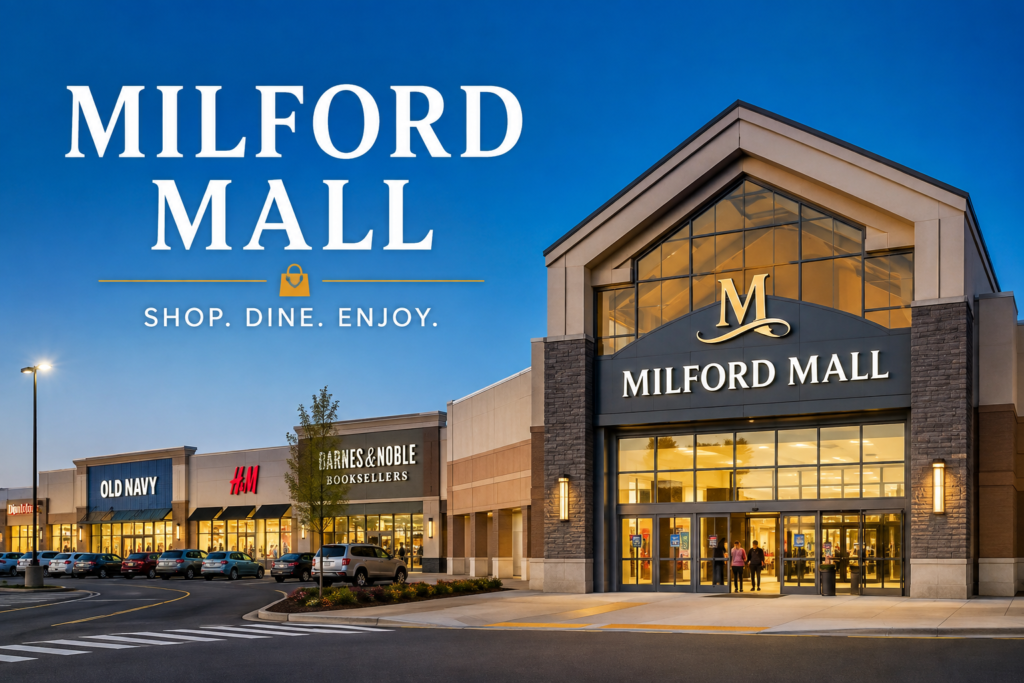
If you are searching for Milford Mall, you are most likely looking for the major shopping destination in Milford, Connecticut, now commonly known as Connecticut Post Mall. Located at 1201 Boston Post Road, the property has been part of Milford’s retail landscape for decades and has changed significantly as shopping habits have evolved. The mall combines department stores, specialty retailers, restaurants, entertainment, fitness, and other services under one roof.
What makes Milford Mall interesting today is that it is more than an old-fashioned shopping center. Like many large malls across the United States, it has faced vacant spaces, changing consumer preferences, and competition from online shopping. At the same time, it continues to attract shoppers, families, and visitors looking for an in-person experience that online stores cannot easily reproduce. Recent activity at the property shows that the story is still developing rather than simply coming to an end.
Whether you are planning a shopping trip, researching the history of Milford Mall, looking for places to eat, or simply curious about its future, there is plenty to know. From its early days as an open-air shopping center to its transformation into a large enclosed mall and its current redevelopment discussions, the property offers an interesting look at how American retail is changing.
What Is Milford Mall and Where Is It Located?
The name Milford Mall has been used in connection with the shopping destination in Milford, Connecticut, although the property is now generally identified as Connecticut Post Mall. It sits on Boston Post Road, one of the important commercial corridors serving Milford and the surrounding communities. Its location makes it accessible to local residents as well as shoppers coming from nearby parts of Fairfield County and the wider region.
The mall occupies an enormous footprint of roughly 1.3 million square feet. That size helps explain why it has remained an important retail property even as the traditional mall model has become more challenging. Rather than being a small neighborhood center, it was designed as a destination where visitors could spend several hours shopping, eating, watching a movie, exercising, or simply spending time with family and friends.
Its position in Milford is also important to understanding its role in the community. The mall is surrounded by a busy commercial environment, meaning visitors can combine a mall trip with other errands and activities in the area. Over the years, that central position has helped make the property one of the recognizable commercial landmarks in Milford.
For someone searching online for Milford Mall, it is therefore useful to understand the name difference. Searching for Connecticut Post Mall will generally provide more current information about the property, while “Milford Mall” may still appear in older references, business listings, discussions, and searches connected with Milford’s shopping history.
The History of Milford Mall
The history of Milford Mall goes back much further than the modern enclosed building shoppers see today. According to information reported about the property, the shopping center originally opened as an open-air mall in 1960. That was a period when suburban shopping centers were becoming increasingly important parts of American communities.
The property later went through a major transformation. It was enclosed in the early 1980s, renovated during the 1990s, and expanded again in 2006. These changes reflected the evolution of American retail, as consumers increasingly expected large indoor shopping environments with climate-controlled corridors, major department stores, restaurants, entertainment, and a broad selection of specialty shops.
That history is significant because Milford Mall was not created as a static property. It has repeatedly been modified to respond to changing expectations. The move from an open-air center to an enclosed mall was one major transformation, while the 2006 expansion represented another attempt to keep the property competitive in a changing retail market.
Today, the mall’s history gives it a different character from newer shopping developments. Some shoppers appreciate the familiarity and nostalgia associated with a traditional mall, while younger visitors may experience it simply as a convenient place to shop and spend time. Its long presence in Milford has also made it part of the city’s commercial identity.
Stores and Shopping Options at Milford Mall
One of the main reasons people visit Milford Mall is the variety of shopping options. The property has historically included major department stores alongside smaller specialty retailers, giving visitors the opportunity to handle several shopping needs during a single trip. Current reported anchors and major retailers include Boscov’s, Dick’s Sporting Goods, H&M, Macy’s, and Target.
Department stores remain particularly useful for shoppers who prefer comparing products in person. Instead of visiting several separate locations, customers can browse clothing, home products, accessories, beauty items, electronics, sporting goods, and other categories in one general area. This broad selection is one of the traditional strengths of a large enclosed shopping mall.
The smaller stores and kiosks also add variety. A large mall can offer products and services that are difficult to find in a single big-box retailer. Visitors may discover fashion accessories, specialty gifts, personal services, seasonal merchandise, and other products while walking between larger stores.
Retail occupancy can change over time, so shoppers should not assume that every store mentioned in older articles or directories is still operating. This is especially important with traditional malls, where leases, renovations, closures, and new openings can change the retail mix. The property has continued to receive new tenants, demonstrating that its commercial identity is still evolving.
Dining at Milford Mall
Shopping can work up an appetite, and Milford Mall offers several ways for visitors to take a break and grab something to eat. The property has a food court as well as restaurants and entertainment venues that provide alternatives to traditional mall dining. Reported restaurants and food-related destinations have included Dave & Buster’s and Buffalo Wild Wings.
A food court is particularly useful for groups because everyone can choose something different without having to agree on one restaurant. One person might want a quick snack, another may prefer a full meal, and children may want something familiar. That flexibility is one reason food courts have remained part of the traditional mall experience.
Full-service or entertainment-oriented restaurants create a different atmosphere. Instead of treating food as a quick stop between stores, visitors can make dining part of the overall outing. This is increasingly important because successful modern malls often compete on experiences rather than relying entirely on merchandise.
Dining options can also change as new businesses move in and existing tenants leave. For that reason, visitors planning a trip specifically around a restaurant should verify its current status and hours before leaving home. The overall food and entertainment mix is one of the areas where Milford Mall’s future could continue to develop.
Entertainment and Family Activities
One of the biggest advantages of a large mall is that it can provide activities beyond shopping. Milford Mall has included entertainment options such as a Cinemark movie theater and Dave & Buster’s, giving visitors reasons to stay longer than they might at a traditional retail strip.
A movie theater changes the purpose of a shopping trip. Someone may visit the mall primarily to see a film and then decide to eat or shop before or afterward. Similarly, an entertainment venue can attract groups of friends and families who might not otherwise spend much time browsing stores.
Family-oriented events can also make a difference. Recent reporting on Black Friday at the Milford mall described activities such as children’s crafts, face painting, story time, and visits with Santa. These types of events show how physical shopping centers can use community activities to create experiences that online shopping cannot offer.
That experience-based approach is becoming increasingly important for malls. A person can buy a shirt or electronic device online within minutes, but shopping with family, seeing a movie, eating together, attending a seasonal event, or meeting friends is a social experience. Milford Mall’s entertainment offerings help support that broader purpose.
Milford Mall and the Changing Shopping Experience
The traditional shopping mall has faced major changes over the last two decades. Online shopping, changing consumer preferences, economic pressures, and the growth of open-air lifestyle centers have all challenged large enclosed malls. Milford Mall has not been immune to these trends. Reporting has pointed to vacant storefronts and the need to create a stronger overall experience for visitors.
At the same time, the mall’s recent traffic suggests that the traditional format still has potential. During Black Friday in 2025, the Milford mall experienced substantial crowds, with shoppers attending sales and families taking part in activities. The atmosphere was described as resembling the busy mall experience associated with earlier generations.
This does not necessarily mean that every traditional mall is returning to its old peak. Instead, it suggests that consumers may still value physical retail when shopping centers give them a compelling reason to visit. Sales, entertainment, restaurants, seasonal activities, and convenient services can work together to create a more complete destination.
That distinction is important. The future of Milford Mall may not depend on returning to exactly what the mall was in the 1980s or 1990s. Instead, its long-term success may depend on becoming something broader: a mixed destination where retail is one part of a larger experience.
Redevelopment Plans and the Future of Milford Mall
One of the most important developments surrounding Milford Mall is the discussion of redevelopment. Milford’s Planning and Zoning Board approved a zoning change that allows up to 750 apartments to be developed at the mall property, with the potential for the housing to be introduced in phases. The approved framework also calls for affordable units and a public plaza.
The proposed first phase has been described as potentially including as many as 250 apartments, along with first-floor retail and restaurants, a public plaza, and green space. The broader idea is to create a mixed-use environment rather than treating the property only as a conventional shopping mall.
This type of redevelopment reflects a larger trend in the retail industry. Developers increasingly see value in combining housing, restaurants, entertainment, services, offices, and shopping. Having people live close to stores can create a more consistent customer base than relying entirely on shoppers who drive to the property.
However, approval of a zoning framework does not automatically mean that construction is complete or that every part of a redevelopment plan is guaranteed to happen exactly as originally discussed. As of reporting in 2025, the property owner had not yet submitted a final proposed design to city officials, although city representatives indicated that the project was moving forward.
New Businesses and Signs of Continued Activity
Despite the challenges facing the traditional mall format, new businesses have continued to show interest in the Milford property. One example is Bristol Bazaar, a marketplace focused on Connecticut-based artisans and small-batch makers. Reporting in 2026 indicated that the business planned to open a second Connecticut location at the mall, adding a different kind of shopping experience to the property.
The planned marketplace is particularly interesting because it does not simply duplicate the traditional department-store model. A collection of local vendors can give shoppers a reason to browse for products they may not find at national chains. That kind of discovery-based shopping can help a mall feel more distinctive.
The property has also seen changes among established retailers. Recent reporting noted that JD Sports replaced Finish Line, while other businesses have been added or adjusted. LA Fitness, meanwhile, decided in 2026 to remain at the mall after previously planning to close its location.
These changes demonstrate that a mall’s tenant list is never completely fixed. Businesses leave, new businesses arrive, and existing tenants sometimes change their plans. For shoppers, that can make repeat visits more interesting because the experience can change from one season to another.
Why Milford Mall Still Matters to the Local Community
Large shopping centers can play a role in a community that extends beyond retail sales. Milford Mall has been part of the local landscape for decades, and its size allows it to function as a gathering point for shopping, entertainment, dining, and seasonal events. Its long history means that different generations of Milford residents may have memories connected to the property.
The community role becomes especially visible during busy shopping periods. The strong Black Friday activity reported at the mall in 2025 showed that people still respond to the combination of deals, family activities, and the excitement of shopping in person.
The mall’s potential redevelopment could make that community role even more significant. If housing, public spaces, restaurants, and retail are integrated successfully, the property could become less dependent on occasional major shopping trips. Residents living nearby could potentially visit for everyday needs, meals, entertainment, or social activities.
This is why the future of Milford Mall is worth watching. The question is not simply whether the mall will remain open. A more interesting question is what kind of destination it will become as consumer habits continue to change.
Tips for Planning a Visit to Milford Mall
If you are planning to visit Milford Mall, it helps to think about what you actually want to accomplish.If your goal is general shopping, allow plenty of time because the property is large and includes a broad mixture of stores. If you are visiting for a particular retailer, restaurant, or entertainment venue, checking its current hours before traveling can save you an unnecessary trip.
Families may want to combine several activities into one outing. For example, shopping can be followed by a meal or entertainment. Seasonal events may also provide additional reasons to visit, especially around major holidays. Because event schedules and tenant hours can change, checking current information before visiting is a smart habit.
Parking is another practical consideration. A large mall naturally has substantial parking areas, but busy shopping periods can make finding a convenient space more difficult. Black Friday and major holiday weekends are particularly likely to be crowded, so visitors who prefer a quieter experience may want to choose a less busy time.
Most importantly, keep an open mind about the mall. Milford Mall is not simply a collection of stores. It represents a changing retail environment where shopping, dining, entertainment, services, and possible residential development are increasingly connected.
Milford Mall Compared With Modern Shopping Centers
Modern shopping centers come in many different forms. Some are traditional enclosed malls, while others are open-air lifestyle centers with restaurants, sidewalks, entertainment, and residential buildings. Milford Mall represents the older enclosed-mall model, but its redevelopment discussions show how that model can evolve.
The biggest advantage of an enclosed mall is convenience. Visitors can move between stores without worrying about rain, snow, extreme heat, or other weather conditions. This can be particularly appealing in Connecticut, where seasonal weather can make outdoor shopping less comfortable.
Another advantage is variety. A large enclosed mall can place department stores, specialty shops, restaurants, entertainment, and services within the same complex. This creates a sense of destination shopping that smaller retail centers may not always provide.
The challenge is keeping the environment fresh. Empty storefronts can make a mall feel less energetic, while a strong mix of retailers and experiences can make the same physical space feel lively. That is why redevelopment, new tenants, entertainment, dining, and community programming are increasingly important parts of the mall’s future.
The Future of Milford Mall
The future of Milford Mall will likely be shaped by a combination of retail performance, redevelopment, consumer behavior, and the willingness of businesses to invest in the property. The proposed residential component could create a major change in how the property functions if it moves forward.
Adding housing could help transform the mall into a more integrated mixed-use destination. Instead of depending entirely on people arriving by car to shop, the development could potentially create a nearby population that uses restaurants, stores, entertainment, and public spaces throughout the week.
At the same time, retail will remain an important part of the property. Current tenants, new businesses, entertainment venues, and seasonal events all contribute to the mall’s ability to attract visitors. The arrival of new concepts such as a local artisan marketplace could also make the shopping experience more distinctive.
Ultimately, Milford Mall’s future is unlikely to be about simply preserving the mall exactly as it looked decades ago. The more realistic direction is adaptation. If the property can combine familiar retail with dining, entertainment, housing, community spaces, and new shopping concepts, it has an opportunity to remain relevant in a retail environment that looks very different from the one in which it began.
Why People Continue Searching for Milford Mall
The continued interest in Milford Mall is easy to understand. People search for the name because they want to know what stores are open, where to eat, what entertainment is available, what is happening with redevelopment, or simply what the property looks like today compared with the mall they remember.
For longtime residents, the mall can carry a strong sense of nostalgia. Shopping centers that have existed for generations become part of people’s personal memories. A store may remind someone of childhood shopping trips, a movie theater may be connected to an old date, or a holiday event may bring back memories of family traditions.
For newer visitors, the appeal is more practical. A large shopping destination offers convenience and variety. You can shop, eat, meet friends, watch a movie, exercise, and take care of other activities without traveling between numerous unrelated locations.
That combination of nostalgia and practicality helps explain why Milford Mall continues to attract attention even while the broader retail industry is changing. The property is both a piece of Milford’s commercial history and a work in progress.
Frequently Asked Questions About Milford Mall
Is Milford Mall the same as Connecticut Post Mall?
Yes, the name Milford Mall is associated with the shopping property in Milford, Connecticut, that is now commonly known as Connecticut Post Mall. The property is located at 1201 Boston Post Road and has undergone several major transformations since opening as an open-air shopping center in 1960.
What stores are at Milford Mall?
Reported major retailers include Boscov’s, Dick’s Sporting Goods, H&M, Macy’s, and Target, along with numerous smaller stores, kiosks, and service businesses. The tenant lineup can change, so shoppers should verify individual stores before visiting.
Does Milford Mall have restaurants?
Yes. The property has a food court and restaurant options, with reported destinations including Dave & Buster’s and Buffalo Wild Wings. Food choices can change as tenants come and go, so current restaurant information is worth checking before a planned visit.
Does Milford Mall have entertainment?
Yes. Entertainment has been an important part of the property’s appeal, including a Cinemark movie theater and Dave & Buster’s. Seasonal family activities have also been held at the mall.
Is Milford Mall being redeveloped?
There are plans and zoning approvals that could allow up to 750 apartments to be developed on the mall property, potentially alongside retail, restaurants, green space, and a public plaza. However, redevelopment plans can change, and reporting in 2025 indicated that a final proposed design had not yet been submitted at that point.
Is Milford Mall still popular?
The mall continues to attract shoppers, particularly during major shopping periods and special events. Black Friday activity in 2025 produced substantial crowds and showed that consumers still value in-person shopping and family-oriented experiences.
Are new businesses coming to Milford Mall?
Yes. New business activity continues to be part of the property’s evolution. For example, Bristol Bazaar announced plans for a second Connecticut location at the mall, offering locally made and artisan products from multiple vendors.
Conclusion
Milford Mall remains an important part of Milford, Connecticut’s commercial landscape, even though its identity has changed significantly over the decades. From its beginnings as an open-air shopping center in 1960 to its later conversion into an enclosed mall, expansion, changing tenant mix, and current redevelopment discussions, the property has continually adapted to new retail realities. Today, the shopping destination offers much more than traditional retail. Major stores, restaurants, entertainment, fitness, seasonal activities, and new businesses all contribute to its appeal. Recent crowds and new tenant activity also show that physical shopping destinations can still attract people when they offer something more than a simple place to buy products.
The biggest story, however, may be what comes next. Plans for housing, public space, restaurants, and additional retail could eventually reshape the property into a more modern mixed-use destination. Whether every proposed element moves forward exactly as planned remains to be seen, but the direction is clear: Milford Mall is evolving rather than simply disappearing.
For shoppers, families, longtime residents, and visitors, that makes the property worth watching. The mall’s history provides a connection to Milford’s past, while its changing retail mix and redevelopment possibilities point toward a very different future. In that sense, Milford Mall is not just a shopping destination—it is an example of how traditional American malls are trying to reinvent themselves for a new generation.
gg