
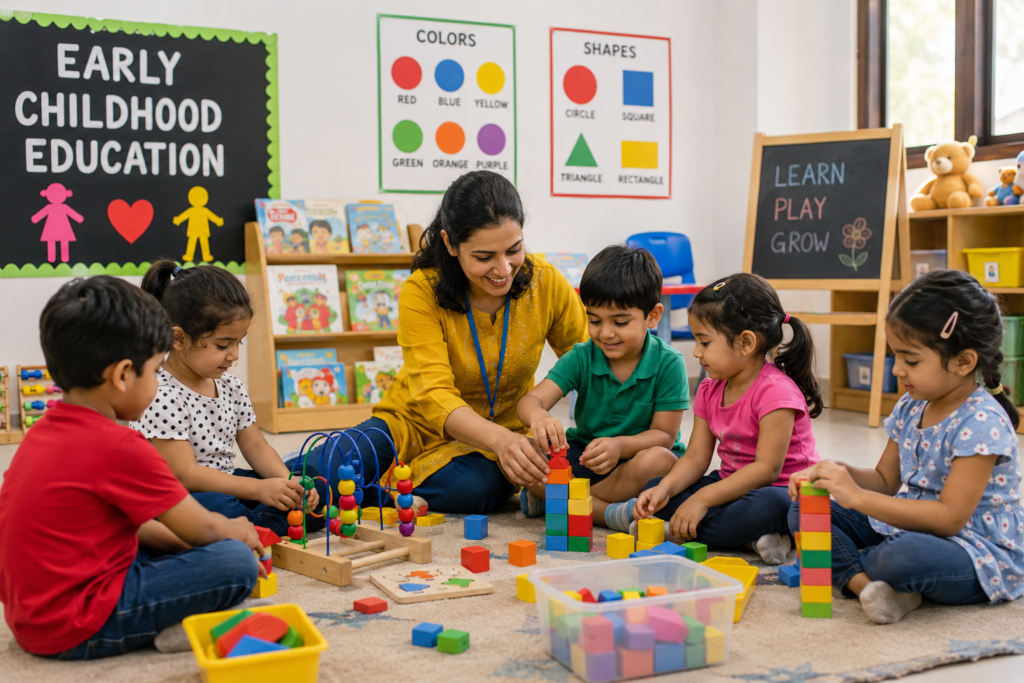
Early childhood education is much more than teaching young children their letters, numbers, colors, and shapes. It is about creating an environment where children can feel safe, explore their surroundings, build relationships, express themselves, and develop the confidence they need for future learning. The early years are a remarkable period of growth, and the experiences children have during this stage can influence how they approach school, relationships, problem-solving, and new challenges later in life.
For parents, teachers, caregivers, and communities, understanding early childhood education can make a real difference. Children do not all learn in exactly the same way or at the same pace. A good early learning environment recognizes those differences and gives children opportunities to learn through play, conversation, creativity, movement, observation, and hands-on activities.
This guide explores the major parts of early childhood education, from social and emotional development to classroom strategies, family involvement, play-based learning, technology, and the qualities that make an early learning program genuinely effective.
What Is Early Childhood Education?
Early childhood education refers to organized learning and care provided during the early years of a child’s life, generally before formal primary education. The exact age range can differ between education systems, but the focus is usually on the period when children are developing rapidly across language, thinking, movement, social skills, and emotional awareness. The goal is not simply to prepare children for the first grade. It is to support the whole child.
A strong early childhood program gives children opportunities to explore and make sense of the world around them. A simple activity such as building a tower with blocks can involve much more learning than it appears to on the surface. Children may be practicing balance, counting, planning, cooperation, communication, and problem-solving at the same time. This is why quality early education often feels playful even when substantial learning is happening.
Another important feature is the relationship between learning and development. Young children need more than academic instruction. They need caring adults who listen to them, encourage curiosity, establish predictable routines, and help them understand their emotions. When children feel respected and secure, they are generally more comfortable trying new things and participating actively in learning experiences.
Why the Early Years Matter So Much
The early years are a period of extraordinary development. Children’s brains are constantly responding to their experiences, relationships, surroundings, and opportunities to practice new skills. This does not mean that every early experience determines a child’s future. Rather, it highlights why supportive environments and responsive relationships are so valuable during childhood.
Early childhood education can introduce children to the routines and expectations associated with group learning. They may learn how to listen while another person is speaking, wait for a turn, clean up materials, follow simple instructions, and work alongside other children. These everyday experiences can make the transition into more formal schooling feel less overwhelming.
The early years also provide an opportunity to identify areas where a child may benefit from additional support. Teachers who spend time observing children can notice differences in communication, movement, attention, social interaction, or learning approaches. When concerns arise, families and professionals can work together to understand the child’s needs and consider appropriate support rather than simply expecting the child to adapt without assistance.
The Role of Play in Early Childhood Education
Play is one of the most natural ways young children learn. When children pretend to run a restaurant, build a house with blocks, draw a picture, play a matching game, or investigate objects outdoors, they are actively developing skills. Play gives children room to make decisions, test ideas, make mistakes, and try again without the pressure associated with formal academic tasks.
Different forms of play support different areas of development. Physical play can strengthen coordination and body awareness, while pretend play can encourage language, imagination, and social understanding. Construction activities can develop planning and spatial reasoning. Games with rules can help children practice memory, attention, cooperation, and self-control.
Teachers can make play even more meaningful by knowing when to step in and when to allow children to take the lead. An adult might introduce a question, add a new material, or encourage children to explain what they are doing. However, constantly controlling the activity can reduce the child’s opportunity to experiment independently. The best approach often combines thoughtful guidance with enough freedom for children to explore their own ideas.
Supporting Social and Emotional Development
Social and emotional development is a central part of early childhood education. Young children are learning how to recognize feelings, communicate needs, develop friendships, handle disagreements, and understand that other people can have different thoughts and emotions. These abilities take time, and children need patient adults who can model appropriate behavior.
Teachers can support emotional learning through ordinary classroom interactions. For example, when two children want the same toy, an adult can help them name the problem, listen to each child’s perspective, and explore possible solutions. This teaches much more than simply telling them to share. Children gradually begin to understand negotiation, empathy, patience, and communication.
A supportive classroom also gives children opportunities to experience success. Encouraging effort instead of focusing only on correct answers can help children develop a healthy attitude toward challenges. Instead of saying, “You’re so smart,” a teacher might say, “You kept trying different ways until you figured it out.” This kind of feedback helps children connect progress with effort, persistence, and learning.
Language and Communication Skills
Language development is another major focus of early childhood education. Children learn language through conversations, stories, songs, questions, games, and everyday interactions. The quality of these interactions matters because children need opportunities to hear language and, just as importantly, opportunities to use it.
Reading aloud is one of the simplest and most valuable classroom activities. A teacher can pause during a story and ask children what they think might happen next, why a character behaved a certain way, or how the story makes them feel. These conversations encourage vocabulary development, listening comprehension, prediction, reasoning, and expressive language.
Children also benefit from adults who genuinely listen to them. A child explaining a drawing or describing something that happened at home is practicing communication. Instead of quickly correcting or redirecting the child, an attentive adult can ask follow-up questions and introduce new vocabulary naturally. These small conversations can turn ordinary moments into meaningful learning opportunities.
Developing Early Math and Thinking Skills
Early mathematics does not have to begin with worksheets and memorized equations. Young children encounter mathematical ideas throughout their daily lives. Counting objects, comparing sizes, sorting toys, noticing patterns, measuring ingredients, identifying shapes, and arranging materials can all introduce important mathematical concepts.
Problem-solving is equally important. Teachers can present children with age-appropriate challenges and allow them to experiment with different solutions. For example, children might be asked how they could build a bridge that holds several toy cars or how they could divide a group of objects fairly. The activity becomes an opportunity to reason, predict, test, and revise.
Children should also be encouraged to explain their thinking. There may be more than one reasonable way to solve a problem, and asking children to describe their approach helps teachers understand their thinking. It also gives children practice using mathematical and logical language. Over time, these experiences can create a strong foundation for more formal mathematics.
Creating an Effective Early Learning Environment
The physical classroom can have a significant influence on children’s learning experiences. A well-designed early learning environment should be safe, welcoming, accessible, and organized around children’s developmental needs. Materials should be easy for children to reach, and different areas can provide opportunities for reading, art, construction, dramatic play, sensory exploration, and quiet activities.
Predictable routines are especially helpful for young children. Knowing what happens next can give children a sense of security and make it easier for them to participate independently. A consistent daily rhythm might include arrival, free exploration, group activities, outdoor play, meals or snacks, rest, and small-group learning. The exact schedule can vary, but reasonable consistency can help children understand expectations.
The classroom should also reflect the children and families who are part of the community. Books, pictures, music, dramatic-play materials, and classroom displays can introduce children to different experiences and perspectives. Representation should feel natural and respectful rather than being limited to occasional special events. Children benefit when they see their own lives reflected while also having opportunities to learn about experiences beyond their immediate surroundings.
The Importance of Qualified Early Childhood Educators
Early childhood educators have a demanding and highly important role. Working with young children requires patience, creativity, observation skills, communication, and an understanding of child development. A teacher may spend part of the morning facilitating a group activity and then quickly shift to helping a child manage frustration, encouraging another child to join a game, or adapting an activity for different learning needs.
Good educators observe before making assumptions. If a child is not participating in an activity, the reason may not be obvious. The child could be tired, uncertain about the instructions, overwhelmed by noise, interested in something else, or struggling with a particular skill. Careful observation helps teachers respond to the actual situation rather than labeling the child unfairly.
Professional development is also important. Research, educational practices, and understanding of children’s needs continue to evolve. Educators can improve their practice by reflecting on classroom experiences, learning from colleagues, communicating with families, and staying informed about effective approaches. A strong teacher is not someone who knows everything; it is someone who continues learning.
Family Involvement in Early Childhood Education
Families are a child’s first and most influential learning partners. Long before children enter a classroom, they learn through everyday experiences at home. Conversations during meals, stories before bedtime, trips to the market, helping with simple household tasks, and playing together can all support development.
Communication between families and educators can make early learning more consistent. Teachers can share observations about a child’s interests and progress, while parents and caregivers can provide information about the child’s routines, personality, strengths, and experiences outside school. This two-way communication helps adults see the child as a whole person rather than viewing development only through classroom performance.
Family involvement does not need to mean attending every school event or completing complicated educational activities at home. Small actions can have a meaningful impact. Reading together, talking about the day, asking children open-ended questions, encouraging independence, and giving them time to play can support learning without making home feel like another classroom.
Inclusive Early Childhood Education
Every child deserves an opportunity to participate in meaningful learning. Inclusive early childhood education recognizes that children may have different abilities, communication styles, backgrounds, interests, and support needs. Instead of expecting every child to learn through one method, educators can adapt materials, instructions, activities, and classroom routines when appropriate.
Inclusion benefits more than children who require additional support. When children learn alongside peers with different strengths and perspectives, they can develop empathy, patience, cooperation, and a broader understanding of human differences. The classroom becomes a community where differences are treated as a normal part of life.
Effective inclusion requires thoughtful planning. Teachers may need to offer visual instructions, additional time, smaller groups, alternative materials, movement breaks, or different ways for children to demonstrate what they know. Collaboration with families and relevant professionals can also help educators make practical decisions that respect each child’s individual needs.
Technology and Early Childhood Learning
Technology is now part of many children’s lives, but its role in early childhood education needs careful consideration. Digital tools can support learning when they are selected thoughtfully and used with clear educational purposes. Interactive stories, creative applications, digital drawing tools, and age-appropriate educational resources can sometimes complement hands-on learning.
However, technology should not replace the experiences young children need most. Children still need conversations with adults, physical movement, imaginative play, social interaction, outdoor exploration, and opportunities to manipulate real objects. A screen can provide information, but it cannot fully replace the value of a child building something with blocks or negotiating a pretend game with classmates.
Teachers and families can focus on quality rather than simply asking whether technology is good or bad. The more useful question is whether a particular digital activity adds something meaningful to the child’s learning. If a tool encourages creativity, communication, exploration, or problem-solving and is used appropriately, it may have a place in the learning environment.
Outdoor Learning and Physical Development
Young children need opportunities to move. Outdoor play provides space for running, jumping, climbing, balancing, throwing, digging, observing nature, and developing physical confidence. These experiences can support gross motor development while also giving children opportunities to explore their environment.
Outdoor learning can also connect physical activity with other areas of development. Children can count objects they find outside, compare leaves, observe insects, listen for different sounds, draw what they see, or talk about changes in weather. A simple walk around a playground or garden can become an informal science, language, mathematics, and observation lesson.
Physical development also includes fine motor skills. Activities such as drawing, cutting with appropriate tools, threading beads, manipulating clay, building with small blocks, and using simple puzzles can strengthen hand and finger coordination. These abilities later support tasks such as writing, dressing, using classroom tools, and handling everyday objects independently.
Building Creativity Through Art and Music
Creative activities give children a way to communicate ideas that they may not yet be able to explain with words. Painting, drawing, singing, dancing, building, storytelling, and dramatic play allow children to experiment and express themselves. The focus should not always be on producing a perfect final product.
When teachers provide open-ended art materials, children can make different choices and develop their own interpretations. One child might use paint to create a recognizable picture, while another might experiment with lines and colors. Both experiences can be valuable. Asking children to explain what they created can add a language and reflection component to the activity.
Music offers similar opportunities. Singing songs, clapping rhythms, moving to music, and experimenting with simple instruments can support listening, coordination, memory, language, and group participation. Music can also make classroom routines more enjoyable. A familiar cleanup song, for example, can turn a transition into a predictable and engaging part of the day.
Observation and Assessment in Early Childhood Education
Assessment in early childhood education should be developmentally appropriate and focused on understanding children’s learning rather than creating unnecessary pressure. Teachers can observe children during play, conversations, routines, and structured activities. These observations can provide useful information about what children already understand and where they may need additional opportunities.
Documentation can include notes, examples of children’s work, photographs where appropriate, developmental observations, or records of conversations. The purpose is to build a clearer picture of the child’s development over time. A single activity rarely tells the complete story, so looking at patterns across different situations can be more informative.
Assessment should also guide teaching. If several children are struggling with a particular concept, the teacher may need to introduce it differently. If a child demonstrates a strong interest in building, that interest can become a starting point for introducing mathematics, vocabulary, science, and problem-solving. In this way, assessment becomes part of teaching rather than something separate from it.
Common Challenges in Early Childhood Education
Early childhood educators face many challenges. Classrooms can include children with very different developmental levels, personalities, languages, interests, and family experiences. Teachers must balance individual needs with the practical realities of managing a group. This requires flexibility and thoughtful planning.
Resources can also vary widely between programs. Some learning environments have extensive materials, outdoor spaces, and support staff, while others operate with limited resources. Creativity can help, but broader investment in early education is important because teachers should not be expected to solve every challenge through personal effort alone.
Another challenge is balancing academic expectations with developmentally appropriate learning. There is understandable interest in helping children succeed academically, but pushing formal academics too aggressively can reduce time for play, movement, social development, creativity, and exploration. Young children need rich learning experiences, not simply more worksheets.
How Parents Can Support Early Learning at Home
Parents and caregivers do not need expensive educational equipment to support early learning. Everyday conversations are incredibly useful. Asking a child what they noticed during a walk, why they think something happened, or what they would do in a particular situation can encourage language and reasoning.
Reading together is another excellent habit. Children can look at pictures, predict what happens next, talk about characters, and connect stories to their own experiences. Even when a child asks for the same favorite story repeatedly, the repetition can support vocabulary, memory, comprehension, and familiarity with storytelling patterns.
Independence should also be encouraged. Young children can help put away toys, choose between appropriate clothing options, carry safe items, help prepare simple food, or organize materials. These tasks may take longer when children do them themselves, but they provide opportunities to practice responsibility, coordination, decision-making, and confidence.
What Makes Early Childhood Education High Quality?
Quality early childhood education is not defined by one specific teaching method or the appearance of a classroom. It is reflected in the overall experience children receive. They should feel safe, respected, supported, and encouraged to explore. Teachers should understand child development and respond to individual differences rather than treating every child exactly the same.
Strong programs also provide meaningful learning opportunities throughout the day. Children should have time for play, conversation, movement, creativity, exploration, and guided learning. Activities should have a purpose, but there should also be room for children’s interests and spontaneous discoveries.
Relationships remain at the heart of quality. A beautiful classroom with expensive materials cannot replace a caring adult who knows the children, listens to them, notices their needs, and encourages their growth. When children experience positive relationships with educators and peers, they are more likely to feel that learning is something enjoyable and worthwhile.
The Long-Term Benefits of Early Childhood Education
The benefits of early learning extend beyond the preschool classroom. Children who develop strong communication, social, emotional, and problem-solving skills have useful foundations for later educational experiences. They learn how to participate in groups, handle challenges, communicate ideas, and approach unfamiliar situations with greater confidence.
Early childhood education can also help children develop positive attitudes toward learning. When children are encouraged to ask questions and explore rather than being afraid of mistakes, they can begin to see challenges as opportunities. That mindset can remain valuable as academic expectations become more demanding.
It is important, however, not to view early education as a guarantee of future success. Children’s development is influenced by many factors, including family relationships, community conditions, health, education, opportunities, and individual characteristics. Early education is one important part of a larger picture, and its greatest value comes from giving children supportive foundations rather than promising a particular outcome.
The Future of Early Childhood Education
The future of early childhood education will likely involve a stronger focus on whole-child development, inclusion, family partnerships, flexible learning environments, and thoughtful use of technology. As educators learn more about how children develop and learn, programs can continue refining their approaches.
There is also increasing recognition that early educators deserve strong professional support. Teachers need training, planning time, appropriate resources, and working environments that allow them to focus on children. Supporting educators is ultimately another way of supporting children because classroom quality depends heavily on the adults who create and maintain the learning environment.
The most promising future is not necessarily one that makes early education more complicated. In many cases, it may mean getting better at the fundamentals: responsive relationships, meaningful play, rich conversations, active exploration, creative expression, family involvement, and respect for individual children. These principles remain valuable even as educational tools and technologies change.
Conclusion
Early childhood education provides children with much more than an introduction to school. It creates opportunities to develop language, confidence, curiosity, social skills, emotional awareness, physical abilities, creativity, and early problem-solving skills. When children are given safe environments and supportive adults, ordinary activities can become powerful learning experiences. The strongest early learning programs understand that children are active participants in their own development. They learn by asking questions, playing, moving, talking, observing, experimenting, making mistakes, and trying again. Teachers and families can support this process by offering guidance without taking away children’s opportunities to explore independently. Ultimately, early childhood education is about giving children a strong beginning. It is not about rushing them toward adulthood or filling every moment with academic tasks. It is about helping them become confident learners who know that their ideas matter, challenges can be approached, relationships are important, and discovering something new can be exciting.
Frequently Asked Questions About Early Childhood Education
What is the main purpose of early childhood education?
The main purpose of early childhood education is to support children’s overall development during their early years. This includes cognitive, language, physical, social, emotional, and creative development. It also helps children develop habits and skills that can make future learning more successful.
Why is play important in early childhood education?
Play allows children to learn through exploration and hands-on experiences. While playing, children can practice communication, cooperation, problem-solving, creativity, movement, decision-making, and self-regulation. Play also gives children opportunities to follow their interests and learn from mistakes in a natural setting.
How can parents support early childhood learning at home?
Parents can support learning through simple everyday activities. Reading together, talking about daily experiences, counting household objects, encouraging imaginative play, exploring outdoors, and involving children in age-appropriate household tasks can all contribute to development. Children generally benefit most when learning feels natural and connected to everyday life.
What skills do children develop through early childhood education?
Children can develop many skills, including early literacy, communication, mathematical thinking, physical coordination, emotional regulation, cooperation, independence, creativity, and problem-solving. The exact skills developed will vary according to the child’s age, experiences, interests, and individual development.
Is technology appropriate for young children?
Technology can have a place in early childhood education when it is used thoughtfully and for an appropriate purpose. Digital activities should complement rather than replace important experiences such as physical play, social interaction, conversations, creative activities, and hands-on exploration. Quality and adult guidance are more important than simply using technology.
How important are teachers in early childhood education?
Teachers play a central role because they create the environment in which children learn. Effective educators observe children’s development, build positive relationships, guide activities, support social and emotional growth, communicate with families, and adapt learning experiences to individual needs.
What should parents look for in an early childhood education program?
Parents can look for a safe and welcoming environment, caring and qualified educators, developmentally appropriate activities, opportunities for play and outdoor learning, good communication with families, inclusive practices, and a balanced approach to learning. The way teachers interact with children is often just as important as the materials available in the classroom.
Can early childhood education prepare children for primary school?
Yes. A quality program can help children become familiar with group routines, communication, cooperation, following directions, problem-solving, independence, and early academic concepts. However, preparation should be developmentally appropriate and should not rely entirely on formal academic instruction.
Why is family involvement important?
Families understand children in ways that classroom observations alone cannot capture. When educators and families communicate regularly, they can share information about a child’s interests, strengths, challenges, routines, and progress. This partnership can create more consistent support for the child.
What is the most important part of early childhood education?
There is no single activity that matters most. Strong relationships, safe environments, meaningful play, responsive teaching, language-rich interactions, movement, creativity, and family involvement all contribute to a positive early learning experience. At the center of all of these elements is the child’s need to feel safe, valued, and encouraged to learn.
YOU MAY HAVE MASSED
