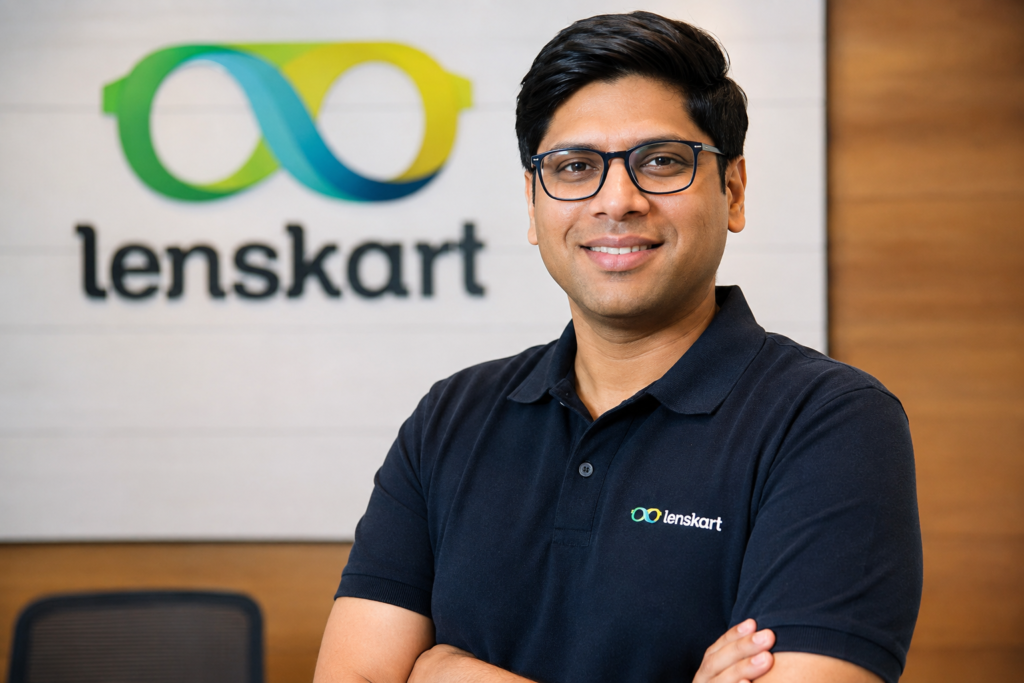
If you have watched Shark Tank India, you have probably come across Peyush Bansal and his straightforward way of evaluating business ideas. As the co-founder of Lenskart and one of the most recognizable faces associated with India’s startup ecosystem, Bansal has built a reputation that extends far beyond television.
One of the most frequently searched questions about him is Peyush Bansal age. Peyush Bansal was born on April 26, 1985. Based on that date of birth, he is 41 years old as of August 25, 2026. His age is interesting not simply as a number, but because his career shows how much can be achieved over four decades through education, experimentation, persistence, and a willingness to solve everyday problems.
His journey is especially worth exploring because Lenskart was not created overnight. The company grew from an online eyewear business into a large omnichannel brand with physical stores, digital platforms, manufacturing capabilities, and international expansion. Lenskart itself identifies Peyush Bansal as its Chairman, Managing Director, CEO, co-founder, and promoter.
Peyush Bansal Age and Date of Birth
The answer to the question Peyush Bansal age is straightforward when his documented date of birth is used. He was born on April 26, 1985, in New Delhi, India. Since his birthday has already passed in 2026, he is 41 years old today.
There has sometimes been confusion online because older biographies continue to display his age from the year in which those pages were published. For example, a biography written several years ago may describe him as being in his late 30s. Those numbers naturally become outdated as time passes. The birth date is therefore a more reliable way to calculate his current age.
At 41, Bansal is at a stage of his career where his role has moved well beyond simply building a startup. Lenskart’s official corporate information currently identifies him as Chairman, Managing Director, and CEO. His story illustrates how an entrepreneur’s responsibilities can evolve as a company moves from an early-stage idea to a major business organization.
Quick Facts About Peyush Bansal
Peyush Bansal’s biography combines technology, entrepreneurship, retail, investment, and television. His date of birth is April 26, 1985, and his birthplace is New Delhi. He studied electrical engineering at McGill University in Canada and later completed a management program at IIM Bangalore.
| Detail | Information |
|---|---|
| Full Name | Peyush Bansal |
| Date of Birth | April 26, 1985 |
| Peyush Bansal Age | 41 years as of August 25, 2026 |
| Birthplace | New Delhi, India |
| Profession | Entrepreneur, business executive, investor |
| Education | McGill University; IIM Bangalore |
| Known For | Co-founding Lenskart |
| Current Lenskart Role | Chairman, Managing Director & CEO |
| Television | Shark Tank India |
| Industry | Eyewear, retail, technology |
These facts give only a quick snapshot. What makes Bansal’s career interesting is the progression behind those details. He did not begin with Lenskart as a fully developed retail empire. His professional journey included education abroad, corporate experience, experimentation with online businesses, and eventually the creation of an eyewear-focused company.
His public image also changed dramatically after his appearance on Shark Tank India. Before the show made him familiar to millions of viewers, he was primarily known within business and startup circles. Television brought his personality, decision-making style, and entrepreneurial philosophy to a much broader audience.
Peyush Bansal Early Life in New Delhi
Peyush Bansal was born and raised in New Delhi. His early education was completed at Don Bosco School, Delhi, before he moved to Canada for higher education.
Growing up in India’s capital city gave him exposure to a rapidly changing environment where traditional businesses and emerging technology were developing alongside one another. Like many entrepreneurs of his generation, he eventually became interested in technology and the possibilities created by the internet.
His early years are important because entrepreneurship is rarely the result of one sudden decision. The habits developed through education, curiosity, problem-solving, and professional experience often become the foundation for later business decisions. In Bansal’s case, those experiences eventually contributed to his approach toward building consumer-focused businesses.
Peyush Bansal Education and Engineering Background
Bansal studied electrical engineering at McGill University in Montreal, Canada. His technical education provided him with a strong foundation in analytical thinking and problem-solving. After completing his engineering degree, he also pursued management education at the Indian Institute of Management Bangalore.
The combination of engineering and management is particularly relevant to his later career. Building a consumer technology company requires more than a good product. Entrepreneurs have to understand customers, operations, finance, supply chains, technology, marketing, and organizational growth. A technical background can help with systems and problem-solving, while management education can provide a broader business perspective.
Bansal’s education also exposed him to different professional environments. Studying in Canada before returning to India gave him an international perspective that would later become useful when thinking about online commerce and consumer experiences. His educational path is a reminder that entrepreneurial success does not necessarily come from one specific degree. More often, it comes from combining knowledge from different areas and applying it to practical problems.
Peyush Bansal Career Before Lenskart
Before becoming synonymous with Lenskart, Peyush Bansal worked at Microsoft. A profile published by the Management Development Institute describes his journey from working as a program manager at Microsoft to eventually becoming an entrepreneur.
Working for a major technology company gave him exposure to large-scale professional systems and the world of technology. However, corporate success did not completely satisfy his entrepreneurial ambitions. He eventually returned to India and began exploring opportunities where technology could be used to solve consumer problems.
This transition is one of the most interesting parts of his career. Leaving a secure corporate position to experiment with entrepreneurship requires a different mindset. A well-paying job offers stability, while a startup usually brings uncertainty. Bansal chose the more uncertain path, and that decision eventually led to the business for which he became famous.
How Lenskart Started
Lenskart’s roots go back to a company originally incorporated as Valyoo Technologies Private Limited. Lenskart’s official history says it was founded in 2008 by Peyush Bansal, Neha Bansal, Amit Chaudhary, and Sumeet Kapahi, while operations in India began as an online business in 2010.
The original concept was centered on changing how consumers purchased eyewear. Instead of relying entirely on traditional retail channels, the founders wanted to combine technology, direct consumer access, manufacturing, and retail innovation. That approach helped the business distinguish itself in a category that had historically depended heavily on physical stores.
The first Lenskart retail store opened in New Delhi in 2013. From there, the company developed an omnichannel model combining online platforms with physical stores. Lenskart’s official history also highlights its expansion into international markets, including Japan, Southeast Asia, and the Middle East.
Peyush Bansal and the Growth of Lenskart
Building Lenskart required much more than launching a website. Eyewear is a product category where customers care about appearance, comfort, prescription accuracy, price, convenience, and trust. The company therefore had to build systems that addressed several parts of the customer journey.
Lenskart’s own account of its early business model emphasizes manufacturing and direct supply, with technology playing an important role in production and quality control. Its earlier corporate story also highlighted robotic lens manufacturing and assembly as part of its effort to maintain precision.
The company gradually developed a combination of online shopping, physical retail, home services, manufacturing, and technology. That combination became one of the central reasons Lenskart could appeal to customers who wanted both digital convenience and the reassurance of an in-person retail experience.
Peyush Bansal on Shark Tank India
For many people, Peyush Bansal became a household name after joining Shark Tank India. The show introduced viewers to his approach to evaluating startups, including his focus on the founder, business model, market opportunity, and ability to execute.
His presence on the show also gave aspiring entrepreneurs an opportunity to see how experienced business leaders question founders. Rather than simply asking about revenue, investors often want to understand customer acquisition, margins, competition, scalability, technology, and long-term potential.
Bansal’s role on the program has become closely connected with his public identity. Lenskart itself has created Shark Tank-related content featuring Bansal and other investors, showing how strongly the company’s brand and the television program have become associated in the public imagination.
Peyush Bansal’s Entrepreneurial Style
One reason viewers remember Bansal is his conversational approach. He often combines business-focused questions with an interest in the founder’s personal motivation. That balance is useful because early-stage businesses are frequently driven by founders who are deeply connected to the problem they are trying to solve.
His approach also reflects the reality that startup investing is not simply about having a clever product. A business may have an attractive idea but still struggle if the market is too small, customer acquisition is expensive, margins are weak, or the team cannot execute.
The broader lesson from his career is that entrepreneurship requires patience. Lenskart did not become a major eyewear company immediately after its launch. It took years of experimentation, investment, operational development, retail expansion, and brand building. His journey therefore provides a useful example of the difference between creating a startup and building a sustainable company.
Why Peyush Bansal Became Successful
There is no single explanation for Bansal’s success. His engineering education, corporate experience, willingness to take risks, understanding of technology, and ability to identify consumer problems all contributed to his entrepreneurial development.
Another important factor was the decision to focus on a specific category rather than trying to build a generic marketplace. Eyewear has recurring customer needs, significant prescription requirements, and opportunities for combining technology with physical retail. By concentrating on that category, Lenskart could develop specialized capabilities instead of competing only as a broad online retailer.
The company’s growth also demonstrates the importance of execution. A good idea may attract attention, but a large consumer business requires warehouses, stores, manufacturing, technology, customer service, employees, supply chains, marketing, and financial discipline. The ability to build those systems over time is a major part of entrepreneurial success.
Peyush Bansal’s Current Role at Lenskart
Peyush Bansal’s role at Lenskart has expanded significantly over the years. Lenskart’s official corporate website currently lists him as Chairman, Managing Director, CEO, Co-founder and Promoter.
In 2025, Lenskart announced Bansal’s appointment as Chairman, Managing Director and CEO for a five-year period beginning June 1, 2025. The company’s annual report records the appointment and identifies him as a key managerial personnel under the applicable corporate framework.
This is an important stage in his career because leadership responsibilities change as a company becomes larger. A founder of a young startup can spend much of the day experimenting with products and talking directly to customers. At a much larger organization, the role involves strategy, governance, leadership, capital allocation, international growth, and long-term planning.
Peyush Bansal and Innovation in Eyewear
Innovation has been an important part of Lenskart’s identity. The company has attempted to use technology not merely as a way to sell glasses online but as part of manufacturing, customer service, product discovery, and retail.
One example is the company’s emphasis on combining digital shopping with physical stores. Eyewear can be difficult to purchase entirely online because customers often want to try frames, check fit, and receive professional assistance. An omnichannel approach allows a customer to move between online and offline experiences.
Lenskart’s official company information says the business began online and later expanded into physical retail, while its current operations also include websites, mobile applications, and other channels. This shows how Bansal’s business strategy evolved alongside changing consumer behavior.
Peyush Bansal’s Leadership Lessons
One of the clearest lessons from Bansal’s journey is the importance of identifying a real consumer problem. Entrepreneurship does not always require inventing something completely new. Sometimes the opportunity lies in improving an existing industry that customers already use.
Another lesson is the value of persistence. A company can face operational problems, competitive pressure, changing consumer expectations, and financial challenges while growing. Staying focused through those difficulties is often more important than having an exciting launch.
His career also demonstrates why entrepreneurs need to keep learning. Bansal’s path moved through engineering, technology, corporate employment, entrepreneurship, retail, manufacturing, investing, and television. Each stage required different skills, and the ability to adapt became part of his professional identity.
Peyush Bansal Age Compared With His Career Milestones
Looking at Peyush Bansal age alongside his career makes his journey easier to understand. Born in 1985, he completed his education, gained corporate experience, and later entered entrepreneurship. Lenskart’s foundations were established in the late 2000s, and its Indian online operations began in 2010.
The company opened its first retail store in 2013, demonstrating that its strategy was moving beyond online commerce. Over the following years, Lenskart expanded its physical and digital presence and eventually entered selected international markets.
Today, at 41, Bansal’s career is a useful example of long-term development rather than overnight success. His achievements were built over many years, and his current leadership position reflects the accumulation of experience gained through different stages of the business.
What Makes Peyush Bansal Popular With Young Entrepreneurs?
Bansal’s popularity among young entrepreneurs comes partly from his visibility on television. However, his appeal goes beyond his role as a Shark. Many aspiring founders see him as an example of someone who left a conventional technology career and built a major consumer business.
His communication style is another factor. Business discussions can sometimes sound complicated, but Bansal generally explains his reasoning in accessible language. This makes his conversations on startup valuation, customer problems, business models, and founder behavior easier for a general audience to follow.
There is also a practical lesson in his story. Young entrepreneurs often focus heavily on launching an idea. Bansal’s career shows that building systems after launch can be just as important. The difficult work of hiring people, improving products, managing operations, developing technology, and earning customer trust often determines whether a startup survives.
Peyush Bansal’s Approach to Business Problems
Bansal’s career reflects a problem-solving approach rather than a purely trend-driven approach. Lenskart entered an industry where customers already needed eyewear, but the buying experience had room for improvement. The company worked around convenience, product choice, technology, manufacturing, and retail access.
This is a useful strategy for entrepreneurs because large opportunities often exist in ordinary industries. A market does not need to look glamorous to be valuable. Everyday products can support enormous businesses when the underlying customer base is large and the company can deliver a better experience.
His journey also highlights the importance of building trust. Eyewear is connected to vision and personal appearance, so customers need confidence in product quality and service. A strong brand therefore becomes an important asset alongside technology and pricing.
Peyush Bansal’s Influence Beyond Lenskart
Bansal’s influence now extends beyond his own company because of his role as a startup investor and television personality. Through Shark Tank India, he has become part of a wider conversation about entrepreneurship in India.
The show has helped make startup concepts more familiar to mainstream audiences. People who may never have studied venture capital or startup finance can now hear founders discuss valuations, equity, revenue, margins, and growth strategies in a televised format.
Bansal’s participation contributes to that educational effect. Whether viewers agree with his investment decisions or not, watching investors challenge founders can encourage people to think more critically about business ideas. That influence is separate from the commercial success of Lenskart itself.
Common Confusion About Peyush Bansal Age
Search results for Peyush Bansal age can sometimes show different numbers. This is usually because websites have not updated their biography pages. For example, an older page may have listed him as 37 or another age that was correct when the article was published.
The most sensible approach is to use the documented birth date rather than relying on an old age label. His date of birth is April 26, 1985. Because today’s date is August 25, 2026, he has already celebrated his birthday this year and is therefore 41 years old.
This distinction matters for anyone publishing biography content. Age is temporary information, while a date of birth remains stable. Updating the calculated age each year helps prevent outdated information from being repeated across the internet.
Peyush Bansal’s Journey as an Inspiration
Peyush Bansal’s story can be encouraging for people who are considering entrepreneurship because it shows that career development does not always follow a straight line. His path included formal education, international experience, employment at a major technology company, and eventually startup building.
His success also demonstrates that entrepreneurs do not have to begin with a revolutionary invention. Sometimes the opportunity is to make an existing product easier to buy, more accessible, better designed, or more convenient.
Perhaps the biggest lesson is patience. Lenskart’s official history spans more than a decade of development, from online operations in 2010 to an increasingly broad physical and digital presence. The company’s evolution shows that meaningful businesses are usually built through thousands of decisions rather than one dramatic moment.
Frequently Asked Questions About Peyush Bansal Age
How old is Peyush Bansal in 2026?
Peyush Bansal is 41 years old as of August 25, 2026. He was born on April 26, 1985, so he celebrated his 41st birthday in April 2026.
When was Peyush Bansal born?
Peyush Bansal was born on April 26, 1985, in New Delhi, India. This date is also the best reference for calculating his current age instead of relying on older biography pages.
What is Peyush Bansal famous for?
Peyush Bansal is best known as the co-founder and CEO of Lenskart and as an investor on Shark Tank India. Lenskart’s official corporate profile currently identifies him as Chairman, Managing Director, CEO, co-founder, and promoter.
What did Peyush Bansal study?
He studied electrical engineering at McGill University in Montreal, Canada, and later completed a management program at IIM Bangalore.
When did Lenskart start?
Lenskart’s history traces back to the founding of Valyoo Technologies in 2008. The business began operations in India as an online business in 2010 and opened its first physical retail store in New Delhi in 2013.
Is Peyush Bansal still associated with Lenskart?
Yes. Lenskart’s current corporate information identifies Peyush Bansal as its Chairman, Managing Director and CEO, in addition to describing him as co-founder and promoter.
Conclusion
The question Peyush Bansal age has a simple answer: he is 41 years old as of August 25, 2026, having been born on April 26, 1985. But the number itself tells only a small part of his story. His career is more interesting when viewed as a timeline. He studied engineering at McGill University, gained professional experience at Microsoft, returned to India, explored entrepreneurship, helped establish the business that became Lenskart, and eventually became one of India’s most recognizable startup investors through Shark Tank India. Lenskart’s development is particularly important to understanding his success. The company moved from online operations to physical retail and later expanded into international markets, while continuing to combine technology with an omnichannel eyewear experience.
At 41, Peyush Bansal is still actively involved in the leadership of Lenskart. His journey offers a practical lesson for aspiring entrepreneurs: age can provide a useful timeline, but experience, adaptability, persistence, and the ability to solve genuine customer problems are what ultimately shape a long-term career.
YOU MAY HAVE MASSED