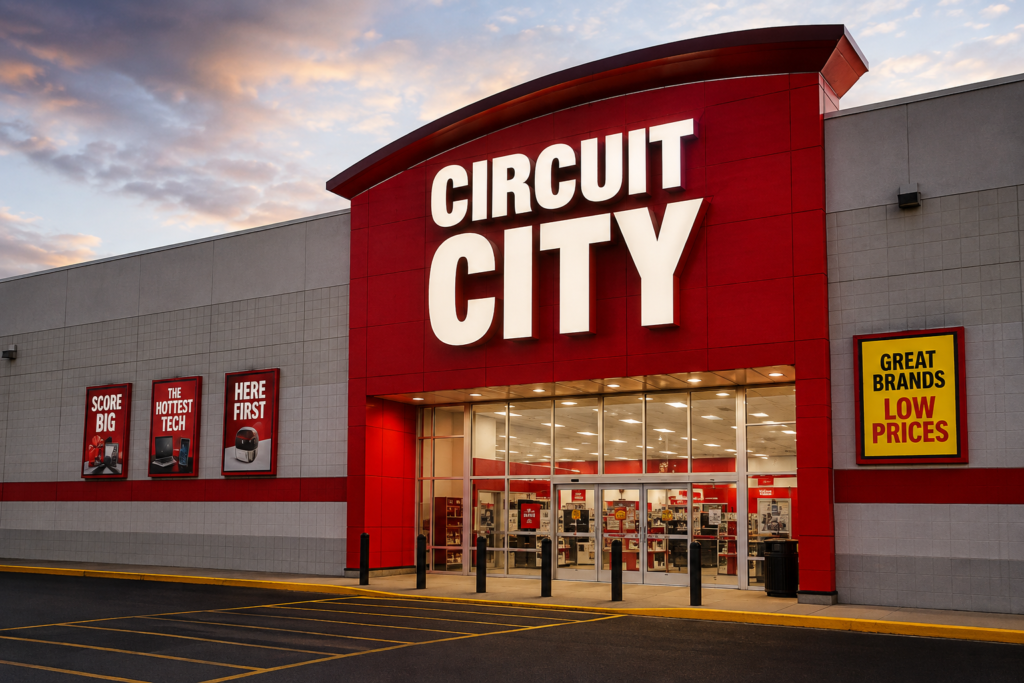
Circuit City is one of the most recognizable names in the history of American electronics retail. Long before online shopping became the normal way to compare televisions, laptops, cameras, gaming systems, and other technology, Circuit City built its reputation by bringing a huge selection of electronics under one roof. For millions of shoppers, visiting a Circuit City store was once a regular part of buying new technology.
The company’s story, however, is much more complicated than simply being a successful electronics retailer that disappeared. Circuit City pioneered retail ideas, experimented with new businesses, expanded rapidly, competed with powerful rivals, and eventually struggled to adapt as the retail industry changed. The original company filed for bankruptcy in 2008 and closed its remaining stores in 2009.
Yet the name did not completely disappear. The Circuit City brand was acquired after the bankruptcy and later revived under new ownership. The modern version has focused heavily on digital commerce and alternative retail concepts rather than attempting to immediately recreate the enormous chain of stores that once defined the brand.
The Early Beginnings of Circuit City
The story of Circuit City began in 1949 when Samuel Wurtzel opened a retail business in Richmond, Virginia, under the name Wards Company. The business was much smaller than the massive electronics chain that Americans would eventually know. At its heart, however, it was built around a simple idea: consumers wanted access to useful household technology at reasonable prices.
The company gradually developed its knowledge of consumer electronics and retail operations. During the early decades, television became an increasingly important part of American households, and retailers that could explain, display, and sell these products had an opportunity to grow. Wurtzel’s company was positioned to benefit from that shift. The Richmond Federal Reserve’s historical account describes the business as beginning as a small storefront before becoming a major national retailer.
A major part of the company’s eventual success came from understanding that electronics could be sold differently from traditional department-store merchandise. Instead of treating televisions and other technology products as small sections within a broader store, the company increasingly emphasized electronics as the main attraction. That strategy eventually helped create the superstore model associated with Circuit City.
How Wards Company Became Circuit City
The name Circuit City did not appear overnight. The company went through a series of changes, acquisitions, and strategic decisions as it attempted to build a larger national presence. In 1984, Wards Company changed its name to Circuit City Stores Inc. and became publicly traded on the New York Stock Exchange under the ticker symbol CC.
The name change reflected a much larger transformation. Circuit City was no longer simply a regional retailer. It was becoming a recognizable national electronics brand with ambitions to compete across the United States. The company had developed a retail format that could be replicated in different markets, making expansion an important part of its strategy.
The Circuit City name also became closely associated with large stores where customers could explore televisions, stereos, computers, appliances, cameras, and other technology products. During the company’s strongest years, its stores offered consumers an experience that was very different from shopping online today. Customers could see products physically, speak with salespeople, compare models, and make a purchase in the same location.
The Superstore Model Changed Electronics Retail
One of Circuit City’s biggest contributions to retail was the development of the electronics superstore. The concept gave consumer electronics a much larger physical footprint and made technology shopping an experience in itself.
The stores were designed around large showrooms and extensive inventory. Customers could walk through different sections and see rows of televisions, audio equipment, computers, appliances, and other products. The model was particularly effective at a time when consumers often wanted assistance before spending hundreds or thousands of dollars on technology.
Circuit City’s sales model also relied heavily on knowledgeable sales associates. Instead of customers simply grabbing products from shelves and heading to a checkout, salespeople played a major role in explaining products and completing purchases. This approach made sense when consumer electronics were complicated and product information was not instantly available through search engines and online reviews.
For a period, the model worked extremely well.Circuit City became one of the most important electronics retailers in the United States and helped establish the large-format electronics store as a mainstream retail concept.
Circuit City’s Growth Into a National Powerhouse
Circuit City’s expansion was impressive.At its peak, the company operated a huge network of locations across the United States and Canada. Retail Dive reports that the company once operated approximately 1,520 stores across the two countries.
The company’s growth reflected the rising importance of consumer electronics. Televisions, VCRs, stereos, computers, game consoles, cameras, and other devices were becoming increasingly common in American homes. Consumers were willing to spend significant amounts of money on new technology, and Circuit City was positioned directly in the middle of that spending.
By 2000, the Richmond Federal Reserve reported that Circuit City employed more than 60,000 people at 616 locations in the United States. That illustrates just how large the company had become.
Circuit City was not simply another retailer at this point. It had become a major American corporation and a household name. Its stores were familiar landmarks in many communities, and its advertising helped make electronics shopping a mainstream activity.
What Made Circuit City Popular With Shoppers
A major reason Circuit City became successful was the breadth of products it offered. Customers could visit one location to shop for a television, stereo, computer, camera, appliance, video game, or related accessory.
This was particularly valuable before consumers had easy access to online marketplaces. If someone wanted to compare several television models, for example, visiting an electronics superstore allowed that person to physically see different screens and talk with a salesperson. The experience could make an unfamiliar purchase feel less intimidating.
Circuit City also built a recognizable brand around technology expertise. During the company’s strongest years, buying electronics could be confusing. Specifications were not always easy to understand, and there were fewer independent sources explaining whether one product was better than another. Sales staff therefore had an important role in helping shoppers make decisions.
That advantage eventually became a weakness, however, because the retail environment changed dramatically. Consumers gained access to product reviews, price comparisons, online forums, manufacturer information, and eventually enormous e-commerce marketplaces.
Circuit City and the Rise of CarMax
One of the more interesting parts of Circuit City’s history is its connection to CarMax. The company experimented with automobile retailing and eventually developed the business that became CarMax.
Circuit City’s automobile concept was unusual for the time. The idea was to provide customers with a large selection of vehicles and a more straightforward purchasing experience. According to historical reporting from CBS News, the company’s automobile operation eventually became CarMax, which was spun off in 2002.
The CarMax story demonstrates that Circuit City was capable of innovation outside traditional electronics retail. CarMax ultimately became a successful standalone company, while Circuit City’s core retail business later experienced serious difficulties.
It is also an important reminder that the original Circuit City was not simply a company that failed to innovate. In several areas, it actually pioneered new approaches. The problem was that innovation in one part of a business does not automatically guarantee that the core operation will remain competitive.
Circuit City’s Early Digital Strategy
It would be unfair to say that Circuit City completely ignored the internet. The company launched its website in 1999 and developed an increasingly sophisticated online operation during the 2000s.
A 2007 SEC filing shows that Circuit City’s direct-to-consumer business had grown rapidly after the launch of its website. Customers could browse a large selection of products, read ratings and reviews, check inventory, purchase online, and arrange store pickup.
That is important because many of today’s retail features were already beginning to appear in Circuit City’s strategy. Online ordering combined with physical store pickup was a powerful concept. The company understood that customers wanted flexibility between digital and physical shopping.
The problem was not necessarily a complete lack of awareness. Instead, Circuit City faced a much larger challenge: its traditional business model, store network, management decisions, cost structure, and competition were changing at the same time.
The Competition Became Increasingly Difficult
Circuit City’s most famous retail rival was Best Buy. Both companies competed for consumers who wanted electronics, computers, appliances, entertainment products, and related services.
Competition became increasingly intense as retailers changed their pricing strategies and consumers became more comfortable comparing products. Best Buy eventually gained significant advantages in areas where Circuit City struggled.
Meanwhile, warehouse clubs, discount retailers, online stores, and specialized sellers created additional pressure. Consumers no longer needed to visit a dedicated electronics store to purchase many of the products Circuit City had traditionally sold.
The internet made the competitive landscape even tougher. Online retailers could offer enormous product selections without maintaining thousands of large physical stores. Customers could compare prices from home and increasingly rely on reviews from other shoppers rather than salespeople.
Problems With Circuit City’s Store Strategy
One of Circuit City’s biggest challenges was its physical store network. Large stores can create a powerful shopping experience, but they are also expensive to operate.
Rent, utilities, employees, inventory, maintenance, and other costs can become difficult to manage when sales decline. A retailer with hundreds or thousands of locations cannot easily reduce its cost structure as quickly as an online competitor.
Historical accounts have also criticized Circuit City for having stores in locations that became less attractive over time. CBS News highlighted problems involving oversized stores, poor locations, management instability, and strategic decisions that weakened the company’s competitive position.
This created a difficult cycle. The company needed strong sales to support its large physical network, but changes in consumer behavior were making that network less productive. Closing stores could reduce expenses, but doing so also reduced the company’s physical presence and revenue opportunities.
The Controversial Decision to Remove Experienced Salespeople
One of the most discussed decisions in Circuit City’s decline involved its sales staff.
The company historically relied on knowledgeable commissioned salespeople. These employees were important because customers often needed help understanding complicated technology. However, Circuit City eventually changed its approach to labor costs and eliminated many experienced sales positions. CBS News reported that the company dismissed thousands of experienced salespeople as part of its cost-cutting efforts.
On paper, reducing labor costs could appear logical. Retailers constantly look for ways to improve efficiency, and wages are a significant expense. But electronics retail is different from selling simple commodity products because customer knowledge can influence purchasing decisions.
When experienced employees leave, a retailer may save money in the short term while losing expertise, customer relationships, and sales capability. Circuit City’s experience became a frequently cited example of how cost-cutting can produce unintended consequences.
The Shift From Expert Shopping to Self-Service Shopping
The retail environment was changing at exactly the wrong time for Circuit City’s traditional model.
Consumers were becoming more knowledgeable. They could search for specifications, read reviews, compare prices, and watch demonstrations online. As a result, the need for a salesperson to explain every product gradually declined.
At the same time, customers increasingly expected lower prices. They could walk into a store, examine a product, and then search online for a cheaper price. This behavior created a difficult problem for traditional electronics retailers.
Circuit City had built much of its identity around helping customers make complicated technology purchases. But as information became abundant and shopping became more self-directed, that advantage became less valuable.
Circuit City and the DIVX Experiment
Circuit City also became associated with an ambitious but unsuccessful entertainment technology experiment called DIVX.
The basic concept was an alternative approach to DVD ownership and rental. Customers would purchase specially designed discs and use compatible equipment under a system that provided limited viewing access unless additional payments were made.
The idea was technically interesting, but consumers did not embrace it. Other retailers were also reluctant to support the format, making widespread adoption difficult. Circuit City eventually abandoned DIVX.
The DIVX story illustrates a broader lesson about technology retail. Being technologically innovative is not enough. A product also needs consumer acceptance, industry support, convenience, and a compelling reason to exist.
Circuit City’s willingness to experiment was admirable, but some experiments consumed attention and resources while competitors were strengthening their positions in the company’s core market.
The 2008 Bankruptcy
The situation became much more serious in 2008. Circuit City filed for Chapter 11 bankruptcy protection in November of that year.
The timing was particularly damaging because the company entered bankruptcy during a severe economic downturn. Consumer spending weakened, credit markets became more difficult, and retailers faced growing pressure from both traditional and online competitors.
According to the company’s SEC filings, Circuit City had been a major specialty retailer selling consumer electronics, computers, entertainment software, appliances, and related services. In fiscal 2008, its domestic segment generated more than $11 billion in sales, demonstrating that bankruptcy did not happen because the company had always been small or insignificant.
The bankruptcy instead represented the collapse of a once-enormous retail model under a combination of strategic, financial, competitive, and economic pressures.
Why Circuit City Ultimately Failed
There was no single reason that explains Circuit City’s collapse. The company faced a combination of problems that reinforced one another.
Its enormous store network became expensive. Competition from Best Buy intensified. Online shopping changed customer expectations. Pricing became more transparent. The company struggled with its sales culture and labor strategy. Management changed frequently, and some strategic decisions failed to produce the desired results.
The financial crisis then arrived at an extremely difficult moment. Circuit City needed flexibility, supplier confidence, and consumer spending to stabilize its business. Instead, it faced a hostile economic environment.
The Richmond Federal Reserve’s historical analysis presents Circuit City’s story as an example of both remarkable retail success and dramatic failure.
The Final Store Closures in 2009
After filing for bankruptcy, Circuit City attempted to find a way forward, but the company was unable to secure the rescue it needed.
In January 2009, the retailer announced plans to liquidate its remaining stores. The Washington Post reported that the company was preparing to close 567 U.S. stores and lay off approximately 34,000 employees.
The liquidation process moved quickly. Stores that had once been symbols of American consumer electronics retail were suddenly filled with going-out-of-business signs and discounted merchandise.
On March 8, 2009, the last Circuit City stores closed. The original retail company was finished.
For longtime customers and employees, the disappearance was more than the closure of another chain. Circuit City had been part of the American retail landscape for decades.
The Circuit City Brand Was Not Gone Forever
Although the original company disappeared, the Circuit City name survived.
In 2009, Systemax acquired the Circuit City brand name, trademarks, and e-commerce website assets. The website was relaunched as an online electronics retailer.
That version of Circuit City did not recreate the old network of giant stores. Instead, it reflected the direction in which retail was moving: online commerce, digital catalogs, and web-based purchasing.
In 2012, Systemax consolidated Circuit City’s online business under the TigerDirect brand, effectively ending that version of the Circuit City experiment.
But the story still had another chapter.
The Circuit City Revival
In 2016, the Circuit City brand was acquired by Ronny Shmoel, who began developing a new version of the company.
The modern company has taken a different approach from the original retailer. Rather than immediately rebuilding hundreds of massive stores, the new business has emphasized digital commerce and alternative ways of connecting technology products with consumers.
The company’s own historical timeline states that it acquired the brand and global trademarks in 2016 and relaunched CircuitCity.com for direct-to-consumer and business-to-business e-commerce in 2018.
This approach makes sense in a retail world where consumers are already comfortable buying electronics online. Recreating the old superstore model would require enormous investment and would expose the company to many of the same fixed costs that contributed to the original chain’s difficulties.
What the Modern Circuit City Represents
The modern Circuit City is best understood as a brand revival rather than a simple recreation of the old company.
The original Circuit City was built around large physical stores. The revived company has focused much more heavily on digital commerce, partnerships, and flexible retail concepts.
This distinction matters. When people hear the name Circuit City, they may remember huge stores filled with televisions and computers. The current business environment is completely different. Consumers can shop from smartphones, compare hundreds of products instantly, read thousands of reviews, and have purchases delivered directly to their homes.
The revived company therefore has an opportunity to use the brand’s historical recognition without necessarily repeating every element of the original business model.
Circuit City’s Approach to Modern E-Commerce
E-commerce gives Circuit City a very different set of opportunities from those available to the original company.
An online retailer does not need to maintain a massive store in every major market. It can reach customers across a much wider geographic area from a digital platform. It can also adjust product selection and marketing much faster.
The modern Circuit City has described its business as both direct-to-consumer and business-to-business e-commerce. Its company history says the website relaunched in 2018 and that the business later developed additional partnership-focused initiatives.
This is a very different Circuit City from the one remembered by shoppers in the 1990s and early 2000s. Yet the underlying goal remains familiar: connect consumers and organizations with technology products.
Why People Still Remember Circuit City
Brand recognition can survive long after a company disappears. Circuit City is a good example.
For former customers, the name brings back memories of shopping for a first computer, television, stereo, video game system, camera, or other piece of technology. The stores were large, brightly marketed, and heavily associated with the excitement of buying new electronics.
Nostalgia is especially powerful when a brand disappears relatively quickly after becoming dominant. Circuit City went from being a major American retailer to closing every store within a matter of months.
That dramatic ending helped preserve its place in retail history. Even people who have not visited a Circuit City store may recognize the name because it remains associated with the rise and fall of big-box electronics retail.
Lessons Businesses Can Learn From Circuit City
Circuit City’s history provides several useful lessons for modern businesses.
The first is that past success can become dangerous if it creates complacency. A business can dominate one market and still lose its position when customer behavior changes.
The second lesson is that cost-cutting should be handled carefully. Reducing expenses can be necessary, but eliminating employees or capabilities that customers genuinely value can weaken the product or service itself.
The third lesson is that innovation needs to focus on the core customer. Circuit City experimented with new ideas, but successful innovation requires more than introducing new technology. Businesses must understand whether customers actually want the new experience.
Finally, physical infrastructure must match consumer behavior. Large stores worked brilliantly during Circuit City’s strongest period, but they became increasingly difficult to justify as consumers moved online.
Circuit City Compared With Today’s Electronics Shopping
Shopping for electronics today is almost unrecognizable compared with the experience consumers had during Circuit City’s peak.
A shopper once might have driven to a large store, spent an hour comparing televisions, asked an employee for recommendations, and taken the product home. Today, that same shopper can compare specifications from multiple manufacturers, watch product demonstrations, read reviews, check prices, and order a television without leaving the house.
The biggest change is not simply technology. It is consumer control. Customers now have access to information that was once controlled largely by retailers and manufacturers.
That change explains why Circuit City’s story remains relevant. The company was built around a retail environment where physical presence and sales expertise mattered enormously. Modern retail rewards speed, convenience, price transparency, digital experience, and flexible fulfillment.
The Importance of Circuit City’s Legacy
Circuit City should not be remembered only as a failed retailer.
Its successes were significant. The company helped popularize the electronics superstore and demonstrated how consumer technology could become a major retail category. Its stores brought products together in a way that made electronics shopping more accessible to ordinary consumers.
Its failures are equally valuable. Circuit City’s collapse shows how quickly a successful business can become vulnerable when competition changes, customers develop new habits, and management decisions fail to keep pace.
The company also left behind a number of ideas that remain visible in retail today, including large electronics-focused stores, online product information, customer reviews, inventory visibility, and online-to-store shopping connections. Its 2007 SEC filing shows that many of these concepts were already part of Circuit City’s digital strategy before its final collapse.
Is Circuit City Still Around Today?
The answer depends on what someone means by “Circuit City.”
The original Circuit City Stores retail chain no longer operates the huge network of stores that existed before the 2009 liquidation. Those physical stores were closed, and the original company ceased operations in March 2009.
However, the Circuit City brand was later acquired and revived. The current company has pursued an e-commerce-centered strategy and has continued developing the brand beyond the original store-based business. Its official history identifies 2016 as the year the brand and global trademarks were acquired and 2018 as the relaunch of CircuitCity.com.
So, while the Circuit City that many Americans remember from the 1990s is gone, the brand itself has not simply vanished.
The Future of the Circuit City Brand
The future of Circuit City depends largely on whether the revived brand can turn its historical recognition into a sustainable modern business.
Brand awareness can be valuable, but nostalgia alone does not create a successful retail company. The modern business has to provide competitive pricing, useful product selection, reliable fulfillment, strong customer service, and a digital experience that gives consumers a reason to choose it over established competitors.
The company’s current strategy suggests that management understands the retail landscape is no longer what it was in the 1980s or 1990s. The focus on e-commerce and partnerships allows the brand to experiment without immediately rebuilding the enormous physical infrastructure of the past.
Whether Circuit City can eventually become a major consumer electronics destination again remains a separate question. But its continued survival as a brand is already an interesting chapter in American retail history.
Circuit City: A Story of Innovation, Mistakes, and Reinvention
Circuit City’s history is ultimately a story about change.
The company began as a small Richmond retailer and developed into a national electronics powerhouse. It helped create the superstore model, sold technology to generations of consumers, experimented with new business ideas, launched an online shopping platform, and became a major American corporation.
Then the environment changed. Competitors became stronger, online shopping accelerated, store economics became more difficult, and internal decisions weakened the company’s position. The 2008 bankruptcy and 2009 liquidation brought the original retail chain to an end.
But the Circuit City name survived. New ownership brought another attempt to build a business around the brand, this time with an emphasis on e-commerce and modern retail concepts.
That makes Circuit City more than a story about a company that went bankrupt. It is a case study in how quickly consumer behavior can change, how difficult it can be for established companies to adapt, and how powerful a recognizable brand can remain even after its original business model disappears.
Frequently Asked Questions About Circuit City
What was Circuit City?
Circuit City was an American consumer electronics retailer that grew from a Richmond, Virginia, business founded in 1949 into a major national chain. It became particularly famous for its large electronics superstores.
When did Circuit City close its stores?
The original Circuit City completed the closure of its remaining stores on March 8, 2009, after filing for bankruptcy in 2008 and entering liquidation.
Why did Circuit City go bankrupt?
Circuit City’s collapse resulted from several factors rather than one single problem. Major issues included intense competition, changing consumer behavior, expensive stores, management and labor decisions, weaker sales, and the difficult economic conditions surrounding the 2008 financial crisis.
Did Circuit City ever have an online store?
Yes. Circuit City launched its website in 1999 and developed its online business substantially during the 2000s. Its website offered product information, customer reviews, online purchasing, inventory information, and store pickup options.
Is Circuit City completely gone?
The original nationwide store chain is gone, but the Circuit City brand was later acquired and revived. The current business has focused on e-commerce and newer retail approaches rather than simply recreating the former store network.
What can businesses learn from Circuit City?
The biggest lesson is that success does not guarantee long-term survival. Businesses must continually adapt to customer behavior, technology, competition, pricing, and changing economic conditions. Circuit City’s history also demonstrates why companies need to protect the capabilities that genuinely create customer value.
Conclusion
Circuit City remains one of the most fascinating stories in American retail. It rose from a small Richmond business to become an electronics giant, helped redefine the superstore, experimented with new technologies and business models, and eventually collapsed under the pressure of changing competition and consumer behavior. Its bankruptcy was a dramatic reminder that even a famous Fortune 500 company can disappear when its business model no longer fits the market. The original chain’s final store closures in 2009 marked the end of an era, but the later revival of the brand showed that a company’s identity can sometimes survive even after its original operation is gone.
YOU MAY HAVE MISSED