The internet is full of tools that promise to make social media research easier, and Dolphin Radar is a name that has started appearing in discussions around Instagram content, audience research, public profiles, Stories, and online activity. Because the name can refer to more than one technology, it is important to understand exactly what people mean when they use the term.
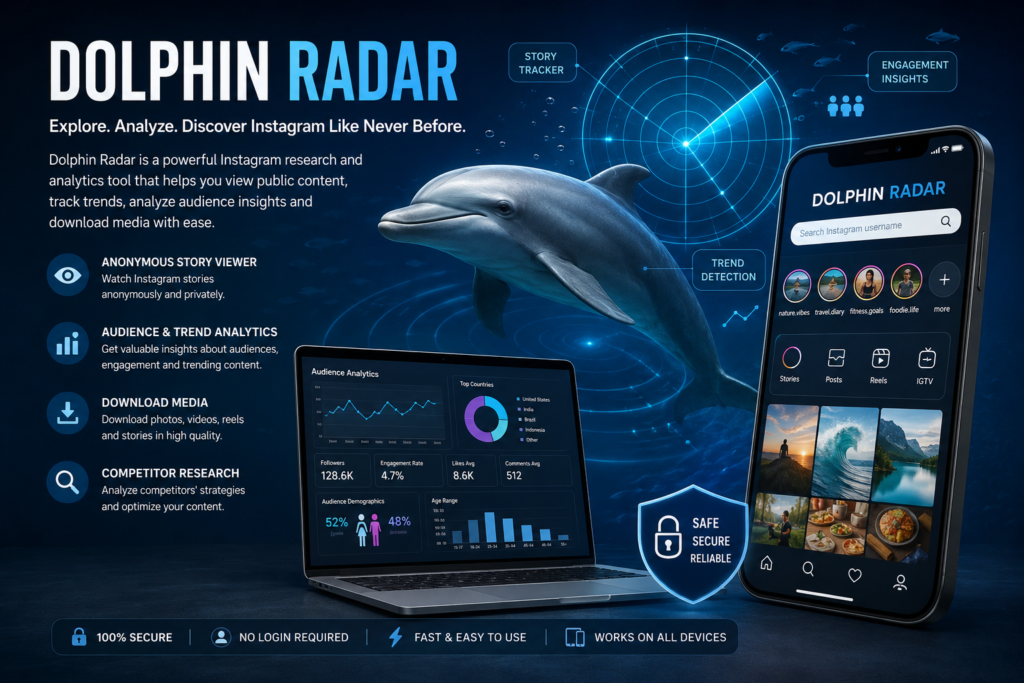
In the social-media context, Dolphin Radar is commonly described as a tool or research approach for examining publicly available Instagram activity. Some online descriptions associate it with viewing or downloading public Instagram Stories, photos, videos, and Reels, while others describe it as a broader audience and trend-research tool.
There is also another meaning worth mentioning. “Dolphin radar” can refer to technology inspired by the echolocation abilities of dolphins. Researchers have explored dolphin-inspired sonar and radar concepts, including systems designed around sophisticated signal processing. This article, however, primarily focuses on the Dolphin Radar associated with Instagram and online social-media research, because that is the version most relevant to everyday internet users.
What Is Dolphin Radar?
Dolphin Radar is generally discussed online as a social-media research and viewing tool associated with Instagram. Instead of treating Instagram simply as a place to scroll through posts, tools described under this name attempt to help users organize, observe, or analyze publicly available content. Depending on the particular service or implementation being discussed, features may include public Story viewing, content discovery, audience research, and downloading publicly accessible media.
The basic idea is fairly straightforward. Instagram produces enormous amounts of public-facing information every day, including posts, Reels, Stories, hashtags, comments, trends, and interactions. For an ordinary user, finding useful patterns in all of that information manually can take a lot of time. A research-oriented tool can make the process more convenient by helping users focus on specific accounts, content types, or trends.
It is important not to assume that every website using the Dolphin Radar name offers exactly the same features. Online descriptions vary considerably. One source presents Dolphin Radar as an Instagram audience and trend research solution, while another describes it as a way to view or download public Instagram content. Therefore, users should always check the actual service they are visiting instead of assuming that every “Dolphin Radar” website works identically.
Why Has Dolphin Radar Become Popular?
Social media has changed from a simple entertainment platform into a major source of information. Businesses watch competitors, creators study successful content, marketers monitor trends, and ordinary users search for posts and Stories that interest them. This creates a natural demand for tools that make social-media observation faster and more organized.
Another reason for the interest is the growing importance of Instagram Stories and short-form video. Posts can remain visible for a long time, but Stories are designed around temporary sharing. That creates a sense of urgency for people who want to follow public content while it is available. Some online descriptions of Dolphin Radar specifically connect the service with anonymous Instagram Story viewing.
There is also a business reason behind the popularity of social-media research tools. A company does not necessarily need millions of followers to learn from Instagram. It can study competitors, identify common customer interests, observe emerging topics, and compare different types of content. Dolphin Radar is therefore better understood as part of a larger trend toward social listening and audience intelligence, rather than as a magic tool that automatically produces successful marketing campaigns.
How Dolphin Radar Can Be Used for Instagram Research
One practical use of Dolphin Radar-style tools is monitoring public Instagram content. A researcher may want to observe how a particular creator presents products, how often a competitor publishes content, or which subjects repeatedly receive attention. Instead of manually opening dozens of profiles every day, a research tool can potentially make that observation more convenient.
For example, imagine a small clothing brand preparing a new campaign. The marketing team could study public posts from competing brands, examine the kinds of Reels they publish, observe common visual styles, and identify recurring themes in their captions. The purpose would not be to copy another business but to understand the market and identify opportunities to create something different.
The same approach can work for content creators. A creator trying to grow on Instagram might analyze successful accounts within the same niche. They could look for patterns in posting frequency, video formats, topics, hooks, and audience reactions. The most valuable lesson is not “copy this creator,” but rather “understand what the audience appears to respond to and develop your own version.”
Dolphin Radar and Anonymous Instagram Story Viewing
Anonymous Story viewing is one of the areas frequently associated with Dolphin Radar online. Services marketed this way claim to allow users to view public Instagram Stories without appearing in the creator’s normal viewer list.
This can sound attractive for people conducting competitor research or simply wanting to observe public content without interacting directly with an account. A marketer, for example, might want to review how competitors use Stories for promotions, announcements, polls, or product launches. In theory, an external viewing interface can make that process more discreet.
However, anonymity claims should always be treated carefully. A website cannot automatically guarantee complete privacy simply because it says “anonymous” on its homepage. Users should consider what information the service collects, whether it requires an Instagram login, what permissions it requests, and whether its privacy policy clearly explains data handling. Avoid entering an Instagram password into an unfamiliar third-party website simply to view public content.
Can Dolphin Radar Download Instagram Content?
Some websites describing Dolphin Radar advertise the ability to download public Instagram photos, videos, Stories, or Reels. This type of functionality can be useful when someone needs temporary offline access to content for legitimate purposes, such as research or personal reference.
However, downloading something that is publicly visible does not automatically mean that the downloader owns the content. Instagram posts, videos, photographs, artwork, and other media can be protected by copyright or other rights. A user should therefore distinguish between accessing public content and republishing or commercially using that content.
A sensible approach is to use downloaded material only when there is a legitimate reason and to respect the original creator. If content needs to be reused publicly, obtaining permission or using content that is specifically licensed for reuse is much safer. A convenient download button does not remove copyright responsibilities.
Dolphin Radar for Businesses and Competitor Research
Businesses can potentially get significant value from social-media research because competitors often reveal useful information through their public content. A company can observe product launches, promotional campaigns, customer questions, seasonal messaging, and general content strategies without needing access to private information.
Suppose a local restaurant is preparing a summer campaign. Its marketing team might study several competing restaurants and examine which public posts receive attention, how menus are presented, what types of videos are used, and how promotions are communicated. Dolphin Radar-style research can become one part of this process, alongside Instagram’s own analytics and other legitimate marketing tools.
The key is to turn observations into insights rather than copying competitors. Good competitive research asks questions such as: What customer problem is this brand addressing? What content format appears repeatedly? Which topics are becoming popular? What does the competitor fail to explain? Those questions can help a business create more useful and original content.
Dolphin Radar for Influencers and Content Creators
Creators often spend hours trying to understand why some posts perform well while others receive little attention. Social-media research tools can help them look beyond individual numbers and identify broader patterns.
A creator could study successful accounts in a particular niche and compare their public content styles. For instance, a fitness creator might examine whether audiences respond more strongly to short demonstrations, educational carousels, personal stories, or transformation-focused videos. A technology creator might compare product reviews, tutorials, quick tips, and news-based content.
The goal should be experimentation rather than imitation. Instagram trends change quickly, and a format that performs well today may become less effective later. A creator who understands the reason behind a trend has a much better chance of adapting successfully than someone who simply copies whatever is currently popular.
Benefits of Using Dolphin Radar
One major benefit associated with Dolphin Radar is convenience. Social-media research can become repetitive when performed manually. Searching profiles, checking Stories, comparing posts, and saving information individually takes time. A specialized tool may simplify some of these activities and give users a more focused workflow.
Another benefit is research efficiency. Instead of randomly browsing Instagram, users can approach the platform with specific questions. They might want to identify emerging topics, understand a competitor’s content strategy, or examine how creators in a niche communicate with their audiences. Structured observation generally produces better results than endless scrolling.
There can also be educational value. New creators and small businesses often learn by observing established accounts. Studying public content can reveal useful lessons about headlines, visual presentation, storytelling, calls to action, video structure, and audience engagement. Used responsibly, a tool such as Dolphin Radar can support learning without replacing creativity or human judgment.
Dolphin Radar vs. Traditional Instagram Browsing
Traditional Instagram browsing is simple: open the application, search for an account, and explore its public content. For casual users, this may be more than enough. There is no need to add another service if the only objective is to browse ordinary public posts.
Dolphin Radar-style tools become more interesting when the goal is research rather than entertainment. A person analyzing multiple accounts may want a workflow that feels more focused than ordinary scrolling. Instead of jumping between unrelated posts, the user can concentrate on a particular niche, creator, competitor, or content type.
Still, third-party tools should not automatically be considered superior to Instagram itself. Instagram provides native features and analytics for many users, particularly professional and creator accounts. When official features provide the information you need, using them can be the simpler and safer option. Third-party services should complement responsible research, not replace official platform functionality unnecessarily.
Privacy and Security Considerations
Privacy should be one of the first things users consider before using any third-party Instagram tool. A service that only works with publicly available content is very different from one that asks for an Instagram username and password. Users should be especially cautious when a website requests login credentials, browser extensions, downloads, or unnecessary permissions.
A strong privacy checklist includes reading the site’s privacy policy, checking whether HTTPS is used, understanding what information is collected, and avoiding suspicious software. If a service makes unrealistic promises, pressures users into downloading unknown applications, or asks for sensitive account credentials without a clear reason, that should be treated as a warning sign.
It is also wise to keep your Instagram account protected with a strong password and two-factor authentication. Third-party websites should never be given more access than necessary. The safest approach is to assume that public-content research does not require handing over private account credentials.
Is Dolphin Radar Safe to Use?
There is no universal answer because “Dolphin Radar” is used by different websites and services, and their features and security practices can differ. Some online articles describe it as a public-content research tool, while others emphasize anonymous Story viewing or media downloading.
For that reason, safety should be evaluated based on the specific website rather than the name alone. Before using any service, check its domain, privacy policy, terms of service, permissions, and reputation. Be particularly cautious if the site asks for payment or sensitive login information without clearly explaining why it is needed.
Users should also remember that no third-party tool can guarantee perfect anonymity or permanent access to Instagram content. Platforms change their systems regularly, and external services can stop working or change their features. A responsible user should therefore avoid treating any online tool as completely risk-free.
Limitations of Dolphin Radar
One limitation is that third-party Instagram tools depend on the availability of public information. If an account is private, content is deleted, a Story expires, or Instagram changes access rules, an external service may not be able to retrieve the information.
Another limitation is accuracy. A research tool may show content, but that does not mean its interpretation is automatically correct. A post receiving many likes does not necessarily mean it generated sales, and a Story receiving fewer visible interactions does not necessarily mean it failed. Social-media performance is more complicated than individual metrics.
There is also the issue of platform rules. Instagram controls access to its platform and can change technical or policy requirements. A service that works today may not work tomorrow. Users should therefore avoid relying completely on one external tool for important business operations or long-term data collection.
Dolphin Radar and Ethical Social-Media Research
Ethical research starts with respecting boundaries. Public content may be visible to everyone, but that does not mean creators expect every piece of content to be copied, redistributed, or used commercially. Responsible users should understand the difference between observing public information and exploiting someone else’s work.
For businesses, ethical research is particularly important. Competitor analysis should focus on learning about markets and customer expectations, not stealing creative assets or pretending to be another brand. A company can study what competitors do successfully while still developing an independent identity.
Creators should follow the same principle. It is perfectly reasonable to learn from other creators, but copying their videos, captions, graphics, or distinctive concepts can damage reputation and create legal problems. The strongest strategy is to use research as inspiration and then build something genuinely original.
How Dolphin Radar Fits Into Modern Social-Media Marketing
Modern social-media marketing is increasingly data-driven. Brands no longer rely only on intuition; they examine engagement patterns, audience behavior, content formats, trends, and competitor activity. Tools associated with social research can help collect observations that support better decisions.
However, data is only useful when it leads to action. A business might discover that short videos are popular in its industry, but that does not automatically mean every short video will succeed. The company still needs a strong message, useful information, good production, appropriate timing, and an understanding of its audience.
Dolphin Radar can therefore be viewed as one potential research component rather than a complete marketing solution. A successful Instagram strategy still depends on creativity, consistency, community interaction, testing, and accurate measurement. No external viewer or analytics service can replace those fundamentals.
The Other Meaning of Dolphin Radar: Dolphin-Inspired Technology
The phrase “dolphin radar” has another fascinating meaning in science and engineering. Dolphins use echolocation, producing clicks and interpreting returning echoes to understand objects around them. Researchers have studied this biological sonar because dolphins can achieve impressive acoustic perception in challenging underwater environments.
One particularly interesting area is biomimetic sonar. Researchers have developed experimental systems inspired by dolphin echolocation, using broadband click-like signals and signal-processing techniques to improve underwater imaging. A published research project described a compact sonar approach based on dolphin-like clicks and processing methods designed to improve shape interpretation.
There is also a technology known as Twin Inverted Pulse Radar, or TWIPR, which was inspired by observations of how dolphins can detect prey amid bubble clouds. The system uses two pulses with opposite polarity, creating a method intended to discriminate certain targets from clutter. This scientific meaning is completely different from the Instagram-related use of the name, but it explains why “Dolphin Radar” can sometimes appear in technology and engineering discussions.
What Makes Dolphin-Inspired Sensing Interesting?
The fascination with dolphins comes from their remarkable ability to use sound in an environment where visibility can be poor. Underwater, light can be limited by depth, particles, and weather conditions, but sound behaves differently. Dolphins exploit acoustic information to locate and investigate objects.
Researchers are interested not because dolphins have literally invented radar, but because their biological sensing system demonstrates useful principles. A dolphin can adjust its acoustic behavior according to the task, interpret returning signals, and extract information from complicated surroundings. Engineers naturally want to understand which aspects of this process can be translated into machines.
Modern research has already shown that dolphin-inspired concepts can contribute to experimental sonar systems. This makes the scientific meaning of Dolphin Radar a genuinely interesting example of biomimicry: studying nature to solve engineering problems.
Common Mistakes People Make When Using Dolphin Radar
One common mistake is assuming that every website with the Dolphin Radar name is the same service. As discussed earlier, the term is used for different concepts, including Instagram-related tools and dolphin-inspired sensing technology. Users should always verify what a particular website actually offers before trusting it.
Another mistake is assuming that anonymous viewing means complete anonymity. Even if a website claims that the Instagram account owner cannot see the viewer, the third-party service itself may still collect technical information such as IP addresses, browser details, or usage data. Reading the privacy policy is therefore important.
A third mistake is downloading and reposting content without considering ownership. Public visibility is not the same thing as permission to reuse. Users should respect copyright, creator rights, Instagram’s rules, and applicable laws whenever they save or share someone else’s work.
How to Get the Most Value From Dolphin Radar
The best way to use a social-media research tool is to begin with a clear objective. Instead of randomly checking accounts, decide what you want to learn. You might be researching competitors, looking for content ideas, monitoring a niche, or studying audience interests.
Keep your research organized. Record recurring themes, successful formats, questions people ask, and gaps in existing content. Over time, these observations can reveal patterns that are difficult to notice during casual browsing.
Most importantly, combine external research with original thinking. Dolphin Radar should not become a shortcut for copying other people. Use it to understand the environment, then create content that offers your own perspective, experience, expertise, and value.
Frequently Asked Questions About Dolphin Radar
What is Dolphin Radar?
Dolphin Radar is a term used online for more than one concept. In the social-media context, it is associated with Instagram research, public-content viewing, and in some cases Story or media downloading. Other uses of the term relate to dolphin-inspired sonar and radar technology.
Can Dolphin Radar view Instagram Stories anonymously?
Some websites marketed under the Dolphin Radar name claim to support anonymous viewing of public Instagram Stories. However, users should not assume that every service offers identical functionality or complete anonymity. Always check the specific service and its privacy practices.
Can Dolphin Radar download Instagram videos?
Some online descriptions associate Dolphin Radar with downloading public Instagram videos, Stories, photos, and Reels. Whether a specific service currently provides that functionality depends on the website and its technical compatibility with Instagram.
Is Dolphin Radar free?
Pricing can vary depending on the particular website or service using the Dolphin Radar name. Some tools may offer free access, while others may have premium features or limitations. Users should check the specific service rather than assuming that the name represents one universal product.
Does Dolphin Radar require an Instagram password?
A legitimate public-content research tool should not automatically require your Instagram password simply to access public information. If an unfamiliar website requests sensitive login credentials, users should be extremely cautious and verify why the information is required before continuing.
Is Dolphin Radar legal to use?
Using a tool to research publicly available information is not automatically illegal, but what a person does with the information can create legal or policy issues. Copyright, privacy, intellectual-property rights, and Instagram’s terms can all matter. Users should use third-party tools responsibly.
Is Dolphin Radar related to actual radar technology?
It can be, depending on the context. “Dolphin radar” is also used informally for dolphin-inspired sensing concepts, including research into sonar and Twin Inverted Pulse Radar. This is different from the Instagram-related meaning of the term.
Can businesses use Dolphin Radar for competitor research?
Businesses can potentially use social-media research tools to observe public competitor activity, identify content patterns, and understand market trends. The most effective approach is to use those observations for strategy and original content rather than copying competitors.
Final Thoughts on Dolphin Radar
Dolphin Radar is an interesting keyword because it sits at the intersection of different areas of technology. In the social-media world, the term is associated with Instagram research, public-content viewing, anonymous Story viewing, and downloading in some online descriptions. In science and engineering, the phrase can point toward fascinating research inspired by the echolocation abilities of dolphins.For everyday Instagram users, the most important lesson is to understand exactly which service they are using. Do not assume that every website called Dolphin Radar offers the same features, security, or privacy protections. Check the website carefully, avoid unnecessary account credentials, and be cautious with downloads.
For businesses and creators, the real value of a tool like this comes from research rather than shortcuts. Public social-media information can reveal useful trends, but successful content still requires originality, creativity, consistency, and a genuine understanding of the audience.
Ultimately, Dolphin Radar should be viewed as a tool or concept rather than a guaranteed solution. Whether you are interested in Instagram research or the fascinating science of dolphin-inspired sensing, the smartest approach is to understand the technology, respect privacy and content ownership, and use information responsibly.
YOU MAY HAVE MISSED