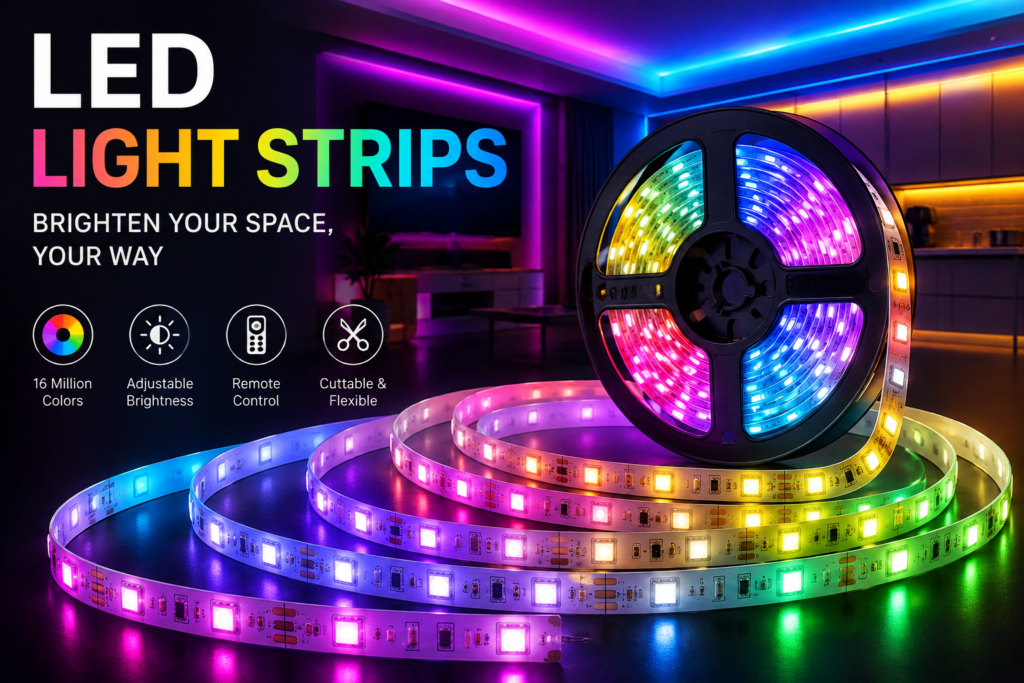
LED light strips have become one of the easiest ways to transform a room without committing to expensive renovations or complicated electrical work. They are flexible, lightweight, energy-efficient, and available in an enormous range of colors, brightness levels, lengths, and control options. Whether you want subtle lighting behind a television, colorful accents around a gaming desk, or practical illumination under kitchen cabinets, LED light strips can fit the job surprisingly well.
What makes them especially appealing is their versatility. Traditional light fixtures are usually designed for one specific location and purpose, while LED strips can be cut, shaped, extended, and installed in places where ordinary bulbs simply would not work. A narrow strip can follow the edge of a shelf, wrap around furniture, run beneath cabinets, or highlight architectural details.
At the same time, buying the first LED strip you see is not always the best approach. Factors such as LED density, color temperature, power consumption, voltage, waterproofing, adhesive quality, brightness, and controller compatibility can make a significant difference. Understanding these basics helps you choose a strip that looks good, lasts longer, and performs properly.
What Are LED Light Strips?
LED light strips are flexible circuit boards containing multiple light-emitting diodes, commonly called LEDs. The LEDs are mounted along a narrow strip and receive electrical power through conductive pathways built into the circuit board. Most strips have an adhesive backing, allowing them to be attached to clean, smooth surfaces.
Unlike conventional bulbs, LED strips distribute light across their entire length. This makes them useful for creating continuous lines of illumination rather than a single concentrated point of light. Depending on the design, the LEDs may produce a single color, adjustable white light, or a wide range of RGB colors.
LED strips are typically powered by low-voltage electricity and may require an appropriate power supply. Some simpler products connect directly to compatible USB ports, while longer or brighter installations often use dedicated adapters. Choosing the correct power source is essential because an undersized supply can cause poor performance, flickering, or overheating.
Why LED Light Strips Are So Popular
One of the biggest reasons people choose LED strips is their flexibility. A strip can be installed around corners, beneath furniture, along walls, inside cabinets, or behind displays. This flexibility gives homeowners and designers far more creative freedom than standard lamps and fixtures.
Energy efficiency is another major advantage. LEDs generally use less electricity than traditional incandescent lighting while producing comparatively little heat. Although actual energy consumption varies according to the strip’s brightness, LED technology remains a practical choice for decorative and accent lighting where lights may be used regularly.
LED strips also offer excellent visual customization. A basic warm-white strip can create a cozy atmosphere, while cool white can provide a cleaner and more modern appearance. RGB and addressable strips can introduce dynamic colors, effects, and patterns, making them particularly popular for bedrooms, entertainment spaces, gaming setups, and events.
Different Types of LED Light Strips
There is no single type of LED light strip that is perfect for every application. One of the simplest categories is single-color strips, which produce one fixed color. These are often available in warm white, neutral white, cool white, red, blue, green, and other colors.
RGB strips contain red, green, and blue LEDs or LED packages capable of producing different colors through combinations of those channels. A compatible controller allows the user to select colors and effects. Some RGB products also include brightness adjustment and preset modes such as fading, flashing, or color cycling.
Another advanced category is addressable LED strips. These strips allow individual LEDs or small LED groups to be controlled separately. That means the strip can display moving patterns, gradients, animations, and other effects rather than showing the same color across its entire length. Addressable models are especially interesting for creative lighting projects and advanced smart-home installations.
Choosing the Right LED Strip Brightness
Brightness is one of the most important factors when selecting LED light strips. A decorative strip placed behind a television does not necessarily need the same output as a strip being used to illuminate a work surface. Looking only at the number of LEDs can therefore be misleading.
Manufacturers may describe brightness using different specifications, including lumens per meter. In general, higher lumen output means the strip can produce more visible light, although the quality and direction of that light also matter. For ambient lighting, moderate brightness may be sufficient, while task lighting usually benefits from a stronger output.
It is also worth considering how the strip will be installed. A strip hidden behind furniture may appear softer because the light reflects off a nearby surface. The same strip mounted directly in an exposed position can look much brighter and may reveal individual LED points.
Understanding LED Density
LED density refers to how many LEDs are placed along a specific length of strip. A higher-density strip usually produces a smoother and more continuous appearance, particularly when the LEDs are visible through a diffuser.
Lower-density strips can be perfectly suitable for decorative applications where the strip itself is hidden. However, when installed inside an aluminum channel with a diffuser, a low-density strip may produce noticeable gaps or a dotted appearance. High-density versions can create a more uniform line of light.
Density can also influence power consumption and heat production. More LEDs operating at higher brightness generally require more electrical power. For this reason, density should be considered together with brightness, strip length, voltage, and power supply requirements.
Choosing Between Warm White and Cool White
White LED strips are commonly available in different color temperatures. Warm white tends to create a softer, more comfortable atmosphere and is often suitable for bedrooms, living rooms, decorative shelves, and hospitality settings.
Cool white produces a cleaner and more energetic appearance. It can work well in garages, workshops, offices, kitchens, and areas where visibility is more important than creating a cozy mood. Neutral white sits between warm and cool options and can provide a balanced appearance.
The best choice ultimately depends on the room and purpose. A warm strip may make a modern workspace feel relaxed, while an extremely cool strip could make a bedroom feel less inviting. Thinking about the atmosphere you want before purchasing can prevent disappointment later.
RGB and Smart LED Light Strips
RGB LED strips are popular because they provide much more control over the appearance of a room. Instead of being limited to white light, users can select different colors and adjust brightness according to their preferences.
Smart LED strips take this concept further by connecting to a smartphone app, wireless controller, or compatible smart-home ecosystem. Depending on the model, users may be able to schedule lighting, create scenes, adjust colors remotely, or synchronize lighting with other devices.
Some advanced products can respond to music or entertainment content. These features can be fun, but they are not necessary for every installation. If the main goal is simple accent lighting, a basic controller may be more practical than paying extra for features that will rarely be used.
Where Can You Use LED Light Strips?
LED strips are useful in almost every part of a home. One popular application is under-cabinet lighting in kitchens. Installed correctly, a strip can provide useful illumination across countertops while also adding a modern decorative element.
Bedrooms are another common location. LED strips can be placed behind headboards, underneath beds, around wardrobes, or along ceilings. Soft indirect lighting can make the space feel more comfortable without requiring a bright overhead fixture.
Living rooms, offices, gaming rooms, staircases, shelves, entertainment centers, and display cabinets are also excellent candidates. Commercial environments can use strips to highlight signs, counters, displays, architectural features, and product shelves.
LED Strips for Gaming Setups
Gaming setups have helped make colorful LED lighting extremely popular. A strip placed behind a monitor or desk can create a glow around the gaming area without shining directly into the user’s eyes.
RGB and addressable strips are particularly useful for this purpose because they can match a preferred gaming theme or create changing effects. Some systems can even synchronize lighting with compatible games, music, or screen activity.
However, more lighting is not always better. Excessive brightness or rapidly changing effects can become distracting. A balanced setup often looks more professional when the LEDs illuminate nearby surfaces rather than being exposed directly to the viewer.
LED Strips for Kitchens and Cabinets
Under-cabinet LED lighting is one of the most practical uses for strip lights. It can improve visibility on countertops while reducing reliance on a single ceiling fixture.
For kitchen applications, choosing a strip with good color quality can be important. High color-rendering performance helps food, ingredients, and surfaces appear more natural under the light. A neutral or warm-white option can work particularly well depending on the kitchen’s existing lighting.
Installation also deserves attention in kitchens. The surface should be clean and dry before applying adhesive, and areas exposed to moisture should use products designed for that environment. The strip should also be positioned so it provides useful illumination without creating uncomfortable glare.
Installing LED Light Strips Properly
Installation begins with planning. Measure the area where the strip will be placed and determine whether the product can be cut at the required points. Many LED strips include clearly marked cutting locations, but cutting outside those points can damage the circuit.
Before sticking the strip permanently, test it. This simple step can prevent a lot of frustration. Connect the strip to its controller and power supply, confirm that the entire length works, and make sure the intended orientation and position look correct.
The mounting surface should be clean, smooth, and free from dust or grease. Although many strips come with adhesive backing, additional clips, mounting channels, or suitable double-sided tape may be useful for long-term installations.
Why LED Strip Adhesive Sometimes Fails
The adhesive backing included with an LED strip can be convenient, but it is not automatically suitable for every surface. Dust, moisture, textured walls, grease, and heat can reduce adhesion.
For kitchen installations, cleaning the surface thoroughly is particularly important because cooking environments can leave behind a thin layer of grease. In other areas, painted or dusty surfaces may also prevent the adhesive from bonding effectively.
For permanent installations, mechanical mounting can provide extra security. Small clips or aluminum channels can hold the strip in place and make future maintenance easier. A professional-looking installation is usually the result of good preparation rather than simply peeling and sticking the strip.
The Importance of LED Strip Power Supplies
The power supply is one of the most important components of an LED strip system. A strip needs a power source that matches its required voltage and can provide enough wattage for its total length.
To estimate the required power, multiply the strip’s power consumption per meter by the total length being installed. It is generally sensible to leave some additional capacity rather than operating a power supply continuously at its maximum rating.
Using the wrong power supply can lead to dimming, flickering, unstable operation, or excessive stress on components. Always check the manufacturer’s specifications and make sure the voltage matches the strip. When dealing with mains electricity, appropriate electrical safety practices are essential.
12V, 24V, and Other LED Strip Voltages
LED strips commonly use low-voltage systems such as 5V, 12V, or 24V. The correct voltage depends on the specific product, and these systems should not be treated as interchangeable.
Higher-voltage strips can be advantageous for longer installations because they may experience less voltage drop over distance. Voltage drop occurs when the electrical voltage becomes lower toward the far end of a strip, potentially causing the LEDs there to appear dimmer.
For long runs, careful planning may involve multiple power injection points, parallel wiring, or selecting a strip designed for longer distances. Following the manufacturer’s recommended installation method helps maintain consistent brightness.
Using Aluminum Channels and Diffusers
Aluminum channels can make an LED strip installation look significantly more polished. The channel provides a dedicated mounting surface while helping manage heat generated by the LEDs.
A diffuser fits over the channel and softens the light. Instead of seeing individual LED points, the viewer sees a more continuous line of illumination. This can be especially valuable in visible installations such as shelves, ceilings, kitchens, and architectural features.
Channels also make cleaning and maintenance easier. They protect the strip from accidental contact and provide a more finished appearance than exposed adhesive-backed tape. For premium installations, the relatively small additional cost can be well worth it.
Waterproof LED Light Strips
Not every LED strip is suitable for wet or outdoor environments. Waterproof and water-resistant products are designed with protective coatings or housings that provide additional resistance against moisture.
The level of protection can vary considerably, so it is important to check the product’s actual rating rather than assuming every coated strip can be submerged. Outdoor installations also need to consider connectors, power supplies, cable entry points, and exposure to weather.
For bathrooms, outdoor spaces, patios, or areas where water may contact the lighting, choose a product specifically designed for that environment. Electrical connections should receive the same level of attention as the LED strip itself.
Common LED Strip Problems and Their Causes
One common problem is flickering. This can result from an unsuitable power supply, poor connections, damaged wiring, or an incompatible controller. Checking each component systematically is usually the fastest way to identify the cause.
Another issue is uneven brightness. If the beginning of a long strip looks bright while the far end appears noticeably dimmer, voltage drop may be responsible. The solution may involve reducing the run length, using additional power connections, or selecting a suitable higher-voltage system.
LED strips can also become detached from surfaces. This usually happens because of poor surface preparation, heat, moisture, or weak adhesive. Mounting clips or channels can provide a more reliable solution when long-term durability matters.
How to Make LED Light Strips Look Professional
A professional-looking installation usually depends more on placement than on expensive equipment. Instead of exposing the LEDs directly, consider hiding the strip so the light reflects from walls, ceilings, or furniture.
Consistency is also important. Try to maintain equal spacing from edges and corners. Uneven placement can make even a high-quality LED strip look improvised.
Cable management is another major factor. Hide excess wiring where possible, secure loose cables, and position controllers and power supplies where they remain accessible without becoming visually distracting. Small details can make a surprisingly large difference.
LED Light Strips and Energy Efficiency
LED technology is known for relatively efficient operation compared with older lighting technologies. However, efficiency varies among products. Two strips of the same length can consume different amounts of electricity depending on LED type, density, brightness, and design.
If energy consumption matters, check the product’s rated wattage rather than judging efficiency from marketing language alone. Smart controls can also help by allowing lights to be scheduled or turned off automatically when they are not needed.
For decorative lighting, lower brightness is often sufficient. Running a strip at maximum brightness all the time may consume more electricity and generate more heat without providing a meaningful visual improvement.
How to Clean and Maintain LED Light Strips
LED strips generally require little maintenance, but dust can accumulate on exposed installations. A soft, dry cloth can usually remove surface dust without damaging the strip.
Avoid soaking electrical components or applying cleaning chemicals directly to the LEDs and circuit board. For installations in kitchens or other environments where grease may accumulate, follow the manufacturer’s recommendations for safe cleaning.
Periodically inspect connectors, wiring, adhesive, and power supplies. If a strip becomes unusually hot, flickers repeatedly, or shows visible damage, it should be switched off and inspected before continued use.
Are LED Light Strips Worth Buying?
For many applications, LED light strips offer an excellent combination of flexibility, affordability, and visual impact. They can provide practical illumination, decorative accents, or dramatic color effects without requiring a major redesign of a room.
Their value depends on choosing the right product for the intended purpose. A cheap strip may be perfectly adequate for a temporary decorative project, while a permanent kitchen or architectural installation may justify spending more on better LEDs, stronger mounting, improved color quality, and a reliable power system.
The key is to think beyond the strip itself. The controller, power supply, mounting method, installation location, and desired lighting effect all contribute to the final result.
Final Thoughts on LED Light Strips
LED light strips have evolved from simple decorative gadgets into versatile lighting tools suitable for homes, offices, entertainment spaces, commercial environments, and creative projects. Their compact size and flexible design make them useful in locations where conventional fixtures can be difficult to install.
The best results come from matching the strip to the application. Consider brightness, color temperature, LED density, voltage, power requirements, waterproofing, control options, and mounting method before making a purchase. A few minutes of planning can prevent many of the common problems associated with strip lighting.
Whether you want a soft glow beneath a cabinet, colorful lighting around a gaming desk, elegant shelf illumination, or a complete smart-lighting setup, LED light strips provide plenty of possibilities. With proper selection and installation, they can turn ordinary spaces into more functional, comfortable, and visually interesting environments without making the project unnecessarily complicated.
YOU ALSO MAY MISSED